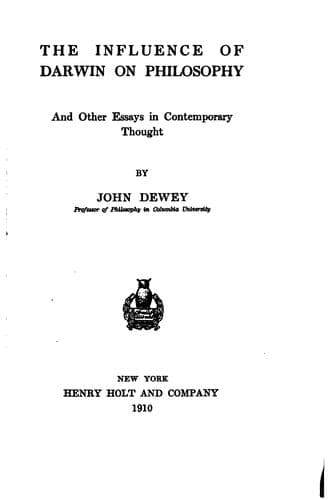
The Influence of Darwin on Philosophy, and other essays in contemporary thoughtDewey, John
Philosophy
The Influence of Darwin on Philosophy, and other essays in contemporary thought
Dewey, John
Evolution; Philosophy; Pragmatism
We have also the conditions of knowledge of the confirmation and
refutation type. In the working out of the situation just described,
in the transformation, self-indicated and self-demanded, of the
tensional into a harmonious or satisfactory situation, fulfilment
_or_ disappointment results. The odor either does or does not fulfil
itself in the rose. The smell as intention is borne out by the facts,
or is nullified. As has already been pointed out, the subsequent
experience of the fulfilment type is not primarily a confirmation or
refutation. Its import is too vital, too urgent to be reduced _in
itself_ just to the value of testing an intention or meaning.[13]
But it gets _in reflection_ just such verificatory significance.
If the smell’s intention is unfulfilled, the discrepancy may throw
one back, in reflection, upon the original situation. Interesting
developments then occur. The smell meant a rose; and yet it did not
(so it turns out) mean a rose; it meant another flower, or something,
one can’t just tell what. Clearly there is _something else_ which
enters in; something else beyond the odor as it was first experienced
determined the validity of its meaning. Here then, perhaps, we have a
transcendental, as distinct from an experimental reference? _Only if
this something else makes no difference, or no detectable difference,
in the smell itself._ If the utmost observation and reflection can find
no difference in the smell quales that fail and those that succeed
in executing their intentions, then there is an outside controlling
and disturbing factor, which, since it is outside of the situation,
can never be utilized in knowledge, and hence can never be employed
in any concrete testing or verifying. In this case, knowing depends
upon an extra-experimental or transcendental factor. But this very
transcendental quality makes both confirmation and refutation,
correction, criticism, of the pretensions or meanings of things,
impossible. For the conceptions of truth and error, we must, upon
the transcendental basis, substitute those of accidental success or
failure. Sometimes the intention chances upon one, sometimes upon
another. Why or how, the gods only know--and they only if to them
the extra-experimental factor is not extra-experimental, but makes
a concrete difference in the concrete smell. But fortunately the
situation is not one to be thus described. The factor that determines
the success or failure, does institute a difference in the thing which
means the object, and this difference is detectable, once attention,
through failure, has been called to the need of its discovery. At the
very least, it makes this difference: the smell is infected with an
element of uncertainty of meaning--and this as a part of the thing
experienced, not for an observer. This additional _awareness_ at least
brings about an additional _wariness_. Meaning is more critical, and
operation more cautious.
Public-domain text, read in full here on John Shaqi.
Reviews
Reviews
No reviews yet
Be the first to share your thoughts on this work.
Elsewhere in the archive
Join the Discussion
Join the discussion
Sign in to leave a comment or review.
Sign InorCreate an account