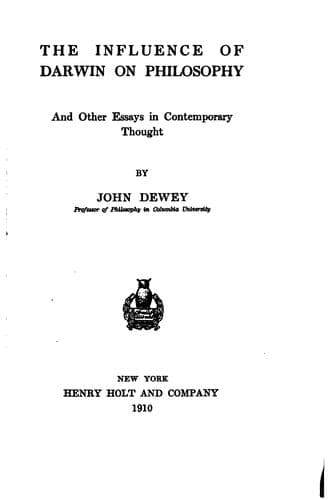
The Influence of Darwin on Philosophy, and other essays in contemporary thoughtDewey, John
Philosophy
The Influence of Darwin on Philosophy, and other essays in contemporary thought
Dewey, John
Evolution; Philosophy; Pragmatism
I have attempted, in the foregoing pages, a description of the function
of knowledge in its own terms and on its merits--a description which
in intention is realistic, if by realistic we are content to mean
naturalistic, a description undertaken on the basis of what Mr.
Santayana has well called “following the lead of the subject-matter.”
Unfortunately at the present time all such undertakings contend with
a serious extraneous obstacle. Accomplishing the undertaking has
difficulties enough of its own to reckon with; and first attempts
are sure to be imperfect, if not radically wrong. But at present the
attempts are not, for the most part, even listened to on their own
account, they are not examined and criticised as naturalistic attempts.
_They are compared with undertakings of a wholly different nature, with
an epistemological theory of knowledge, and the assumptions of this
extraneous theory are taken as a ready-made standard by which to test
their validity._ Literally of course, “epistemology” means only theory
of knowledge; the term _might_ therefore have been employed simply as
a synonym for a descriptive logic; for a theory that takes knowledge
as it finds it and attempts to give the same kind of an account of it
that would be given of any other natural function or occurrence. But
the mere mention of what _might_ have been only accentuates what is.
The things that pass for epistemology all assume that knowledge is not
a natural function or event, but a mystery.
Epistemology starts from the assumption that certain conditions lie
back of knowledge. The mystery would be great enough if knowledge
were constituted by non-natural conditions back of knowledge, but the
mystery is increased by the fact that the conditions are defined so
as to be incompatible with knowledge. Hence the primary problem of
epistemology is: How is knowledge _überhaupt_, knowledge at large,
_possible_? Because of the incompatibility between the concrete
occurrence and function of knowledge and the conditions back of it to
which it must conform, a second problem arises: How is knowledge in
general, knowledge _überhaupt_, _valid_? Hence the complete divorce
in contemporary thought between epistemology as theory of knowledge
and logic as an account of the specific ways in which particular
beliefs that are better than other alternative beliefs regarding the
same matters are formed; and also the complete divorce between a
naturalistic, a biological and social psychology, setting forth how
the function of knowledge is evolved out of other natural activities,
and epistemology as an account of how knowledge is possible anyhow.
Public-domain text, read in full here on John Shaqi.
Reviews
Reviews
No reviews yet
Be the first to share your thoughts on this work.
Elsewhere in the archive
Join the Discussion
Join the discussion
Sign in to leave a comment or review.
Sign InorCreate an account