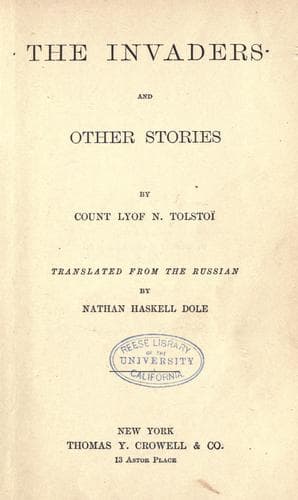
Russian fiction -- Translations into English; Short stories, Russian -- Translations into English
"At Dargi?" asked the infantry man, standing up and picking up his
pipe, and again frowning and shaking his head.... "There were all sorts
of things there."
And he left us.
"Say, are there many of the soldiers in our battery who were at Dargi?"
I asked.
"Let us see;[30] here is Zhdánof, myself, Patsan,--who is now on
furlough,--and some six men more. There wouldn't be any others."
"Why has our Patsan gone off on leave of absence?" asked Chikin,
shaking out his legs, and laying his head on a log. "It's almost a year
since he went."
"Well, are you going to take your furlough?" I asked of Zhdánof.
"No, I'm not," he replied reluctantly.
"I tell you it's a good thing to go," said Antónof, "when you come from
a rich home, or when you are able to work; and it's rather flattering
to go and have the folks glad to see you."
"But how about going when you have a brother,", asked Zhdánof, "and
would have to be supported by him? They have enough for themselves, but
there's nothing for a brother who's a soldier. Poor kind of help after
serving twenty-five years. Besides, whether they are alive or no, who
knows?"
"But why haven't you written?" I asked.
"Written? I did send two letters, but they don't reply. Either they are
dead, or they don't reply because, of course, they are poor. It's so
everywhere."
"Have you written lately?"
"When we left Dargi I wrote my last letter."
"You had better sing that song about the birch," said Zhdánof to
Antónof, who at this moment was on his knees, and was purring some song.
Antónof sang his "Song of the White Birch."
"That's Uncle Zhdánof's very most favorite song," said Chikin to me in
a whisper, as he helped me on with my cloak. "The other day, as Filipp
Antónuitch was singing it, he actually cried."
Zhdánof at first sat absolutely motionless, with his eyes fastened on
the smouldering embers, and his face, shining in the ruddy glow, seemed
extraordinarily gloomy; then his cheek under his mustaches began to
move quicker and quicker; and at last he got up, and, spreading out
his cloak, he lay down in the shadow behind the fire. Either he tossed
about and groaned as he got ready for bed, or the death of Velenchúk
and this wretched weather had completely upset me; but it certainly
seemed to me that he was weeping.
The bottom of the log which had been rolled on the fire, occasionally
blazing up, threw its light on Antónof's form, with his gray moustache,
his red face, and the ribbons on the cloak flung over his shoulders,
and brought into relief the boots, heads, or backs of other sleeping
soldiers.
From above the same wretched drizzle was falling; in the atmosphere
was the same odor of dampness and smoke; around us could be seen the
same bright dots of the dying fires, and amid the general silence the
melancholy notes of Antónof's song rang out. And when this ceased for a
moment, the faint nocturnal sounds of the camp, the snoring, the clank
of a sentinel's musket, and quiet conversation, chimed in with it.
Public-domain text, read in full here on John Shaqi.
Reviews
Reviews
No reviews yet
Be the first to share your thoughts on this work.
Elsewhere in the archive
Join the Discussion
Join the discussion
Sign in to leave a comment or review.
Sign InorCreate an account