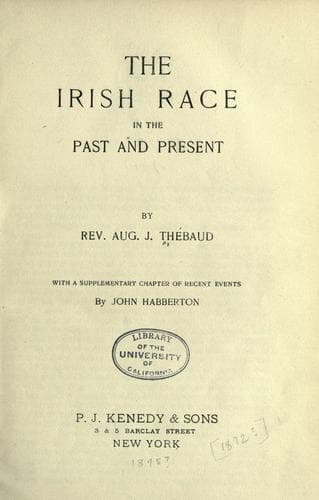
The Irish Race in the Past and the PresentThébaud, Augustus J.
History
The Irish Race in the Past and the Present
Thébaud, Augustus J.
Ireland -- History
"All over Gaul," he says, "there are two classes of men who enjoy
all the honors and social standing in the state--the Druids and
the knights. The plebeians are looked upon almost as slaves, having
no share in public affairs. Many among them, loaded with debt,
heavily taxed, or oppressed by the higher class, give themselves
in servitude to the nobility, and then, _in hos eadem omnia sunt
jura quoe dominis in servos_, the nobles lord it over them as, with
us, masters over their slaves."
It is clear from this very passage that among the Celts no such
servile class existed as among the Romans and other nations of
antiquity. The plebeians, as Caesar calls them, that is to say,
the simple clansmen, held no office in the state, were not summoned
to the councils of the nation, and, on that account, were nobodies
in the opinion of the writer. But the very name he gives them -
_plebs_ - shows that they were no more real slaves than the Roman
plebs. They exercised their functions in the state by the elections,
and Caesar did not know they could reach public office by application
to study, and by being _ordained_ to the rank of file, or shanachy,
or brehon, in Ireland, at least: and this gave them a direct share
in public affairs.
He adds that debt, taxation, and oppression, obliged a great many
to give themselves in servitude, and that then they were among
the Celts what slaves were among the Romans.
This assertion of Caesar requires some examination. That there
were slaves among the Gaels, and particularly in Ireland, we know
from several passages of old writers preserved in the various
annals of the country. St. Patrick himself was a slave there in
his youth, and we learn from his history and other sources how
slaves were generally procured, namely, by piratical expeditions
to the coast of Britain or Gaul. The Irish _curraghs_, in pagan
times, started from the eastern or southern shores of the island,
and, landing on the continent or on some British isle, they captured
women, children, and even men, when the crew of the craft was strong
enough to overcome them; the captives were then taken to Ireland
and sold there. They lost their rights, were reduced to the state
of "chattels," and thus became real slaves. Among the presents
made by a superior to an inferior chieftain are mentioned bondsmen
and bondsmaids. We cannot be surprised at this, since the same
thing took place among the most ancient patriarchal tribes of the
East, and the Bible has made us all acquainted with the male and
female servants of Abraham, Isaac, and Jacob, who are also called
bondsmen and bondswomen. Among the Celts, therefore, slaves were
of two kinds: those stolen from foreign tribes, and those who
had, as it were, sold themselves, in order to escape a heavier
oppression: these latter are the ones mentioned by Caesar.
Public-domain text, read in full here on John Shaqi.
Reviews
Reviews
No reviews yet
Be the first to share your thoughts on this work.
Join the Discussion
Join the discussion
Sign in to leave a comment or review.
Sign InorCreate an account