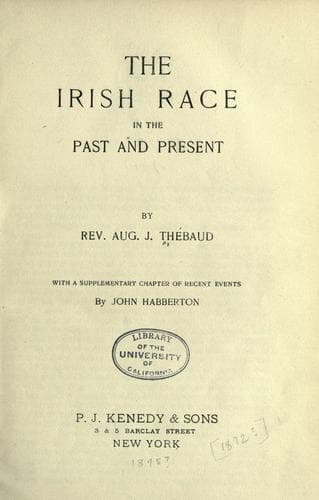
The Irish Race in the Past and the PresentThébaud, Augustus J.
History
The Irish Race in the Past and the Present
Thébaud, Augustus J.
Ireland -- History
This, therefore, not only imparted a peculiar character to the
people, but also gave to each subordinate chieftain an immense
power over his clan; and it is doubtful if the whole history of
the country can afford a single example of the clansmen refusing
obedience to their chief, unless in the case of great criminals
placed by their atrocities under the ban of society in former
times, and under the ban of the Church, since the establishment
of the Christian religion among them.
The previous observations give us an insight into the state of
the people in Celtic countries. Since, however, we know that
slavery existed among them, we must consider a moment what kind
of slavery it was, and how soon it disappeared without passing,
as in the rest of Europe, through the ordeal of serfdom.
At the outset, we cannot, as some have done, call slaves the
conquered races and poor Milesians, who, according to the ancient
annals of Ireland, rose in insurrection and established a king of
their own during what is supposed to be the first century of the
Christian era. The _attacotts_, as they were called, were not
slaves, but poor agriculturists obliged to pay heavy rents: their
very name in the Celtic language means "rent-paying tribes or
people." Their oppression never reached the degree of suffering
under which the Irish small farmers of our days are groaning. For,
according to history, they could in three years prepare from their
surplus productions a great feast, to which the monarch and all
his chieftains, with their retinue, were invited, to be treacherously
assassinated at the end of the banquet. The great plain of Magh Cro,
now Moy Cru, near Knockma, in the county of Galway, was required
for such a monster feast; profusion of meats, delicacies, and
drinks was, of course, a necessity for the entertainment of such
a number of high-born and athletic guests, and the feast lasted
nine days. Who can suppose that in our times the free cottiers
of a whole province in Ireland, after supporting their families
and paying their rent, could spare even in three years the money
and means requisite to meet the demands of such an occasion? But
the simple enunciation of the fact proves at least that the attacotts
were no slaves, but at most merely an inferior caste, deprived of
many civil rights, and compelled to pay taxes on land, contrary
to the universal custom of Celtic countries.
Caesar, it is true, pretends that real slavery existed among the
Celts in Gaul. But a close examination of that short passage in
his "Commentaries," upon which this opinion is based, will prove
to us that the slavery he mentions was a very different thing from
that existing among all other nations of antiquity.
Public-domain text, read in full here on John Shaqi.
Reviews
Reviews
No reviews yet
Be the first to share your thoughts on this work.
Join the Discussion
Join the discussion
Sign in to leave a comment or review.
Sign InorCreate an account