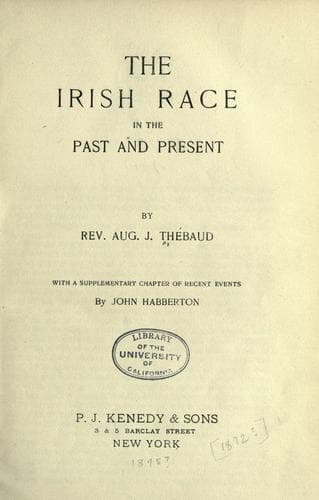
The Irish Race in the Past and the PresentThébaud, Augustus J.
History
The Irish Race in the Past and the Present
Thébaud, Augustus J.
Ireland -- History
Servitude, therefore, continued in Ireland after the establishment
of Christianity; but how different from the slavery of other
European countries, which it took so many ages to destroy, and
which had to pass through so many different stages! Although we
cannot know precisely when servitude was completely abolished
among the Celts, the total silence of the contemporary annals on
the subject justifies the belief that the Danes, on their first
landing, found no real slaves in the country; and, if the Danes
themselves oppressed the people wherever they established their
power, they could not make a social institution of slavery. It
had never been more than a domestic arrangement; it could not
become a state affair, as among the nations of antiquity.
In clannish tribes, therefore, and particularly among the Celts,
the personal freedom of the lowest clansman was the rule, deprivation
of individual liberty the exception. Hence the manners of the people
were altogether free from the abject deportment of slaves and
villeins in other nations--a cringing disposition of the lower
class toward their superiors, which continues even to this day
among the peasantry of Europe, and which patriarchal nations have
never known. The Norman invaders of Ireland, in the twelfth century,
were struck with the easy freedom of manner and speech of the
people, so different from that of the lower orders in feudal
countries. They soon even came to like it; and the supercilious
followers of Strongbow readily adopted the dress, the habits, the
language, and the good-humor of the Celts, in the midst of whom
they found themselves settled.
And it is proper here to show what social dispositions and habits
were the natural result of the clan system, so as to become
characteristic of the race, and to endure forever, as long at least
as the race itself. The artless family state of the sept naturally
developed a peculiarly social feeling, much less complicated than
in nations more artificially constituted, but of a much deeper and
more lasting character. In the very nature of the mind of those
tribes there must have been a great simplicity of ideas, and on
that account an extraordinary tenacity of belief and will. There
is no complication and systematic combination of political, moral,
and social views, but a few axioms of life adhered to with a most
admirable energy; and we therefore find a singleness of purpose,
a unity of national and religious feeling, among all the individuals
of the tribe.
Public-domain text, read in full here on John Shaqi.
Reviews
Reviews
No reviews yet
Be the first to share your thoughts on this work.
Join the Discussion
Join the discussion
Sign in to leave a comment or review.
Sign InorCreate an account