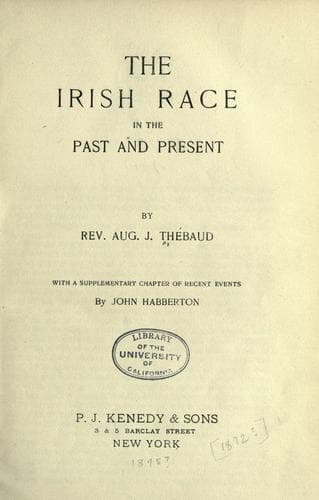
The Irish Race in the Past and the PresentThébaud, Augustus J.
History
The Irish Race in the Past and the Present
Thébaud, Augustus J.
Ireland -- History
The evident consequence of this well-attested fact is that the
pagan Celts, even of the highest rank, generally led pure lives,
and admired chastity. But there is something more. Morality rests
on the sense of duty; the deeper that sense is imprinted in the
heart of man, the more man becomes truly moral and holy. It can
be almost demonstrated that scarcely any thing gives more solidity
to the sense of duty than a simple and patriarchal life. Their
views of morals being no more complicated than their views of
any thing else; being accustomed to reduce every thing of a
spiritual, moral nature to a few feelings and axioms, as it were,
but at the same time becoming strongly attached to them on account
of the importance which every man naturally bestows on matters of
that sort; what among other nations forms a complicated code of
morality more or less pure, more or less corrupt, for the nations
of which we speak becomes compressed, so to speak, in a nutshell,
and, the essence remaining always at the bottom, the idea of duty
grows paramount in their minds and hearts, and every thing they
do is illumined by that light of the human conscience, which,
after all, is for each one of us the voice of God. False issues
do not distract their minds, and give a wrong bias to the
conscience. Hence Celtic tribes, by their very nature, were
strictly conscientious.
So preeminently was this the case with them that spiritual things
in their eyes became, as they truly are, real and substantial.
Hence their religion was not an exterior thing only. On the contrary,
exterior rites were in their eyes only symbolical, and mere emblems
of the reality which they covered.
It should, therefore, be no matter of surprise to us to find that
for them religion has always been above all things; that they have
always sacrificed to it whatever is dear to man on earth. They all
seem to feel as instinctively and deeply as the thoroughly cultivated
and superior mind of Thomas More did, that eternal things are
infinitely superior to whatever is temporal, and that a wise man
ought to give up every thing rather than be faithless to his religion.
From the previous remarks, we map conclude, with Mr. Matthew
Arnold, who has applied his critical and appreciative mind to the
study of the Celtic character, that "the Celtic genius has sentiment
as its main basis, with love of beauty, charm, and spirituality
for its excellence," but, he adds, "ineffectualness and self-will
for its defects." On these last words we may be allowed to make a
few concluding observations.
Public-domain text, read in full here on John Shaqi.
Reviews
Reviews
No reviews yet
Be the first to share your thoughts on this work.
Elsewhere in the archive
Join the Discussion
Join the discussion
Sign in to leave a comment or review.
Sign InorCreate an account