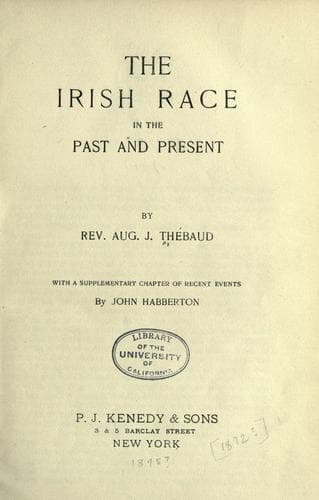
The Irish Race in the Past and the PresentThébaud, Augustus J.
History
The Irish Race in the Past and the Present
Thébaud, Augustus J.
Ireland -- History
The Asiatic and African races, the posterity of Sem and Cham,
appear in our days destitute of all energy, and incapable not
only of ruling over foreign races, but even of standing alone and
escaping a foreign yoke. It has not been so from the beginning.
There was a period of wonderful activity for them. Asia and Africa
for many ages were in turn the respective centres of civilization
and of human history; and the material relics of their former
energy still astonish all European travellers who visit the Pyramids
of Egypt, the obelisks and temples of Nubia and Ethiopia, the
immense stone structures of Arabia, Petraea and Persia, as well
as the stupendous pagodas of Hindostan. How, under a burning sun,
men of those now-despised races could raise structures so mighty
and so vast in number; how the ancestors of the now-wretched Copt,
of the wandering Bedouin, of the effete Persian, of the dreamy
Hindoo, could display such mental vigor and such physical endurance
as the remains of their architectural skill and even of their
literature plainly show, is a mystery which no one has hitherto
attempted to solve. Nothing in modern Europe, where such activity
now prevails, can compare with what the Eastern and Southern races
accomplished thousands of years ago. Ethiopia, now buried in sand
and in sleep, was, according to Heeren, the most reliable observer
of antiquity in our days, a land of immense commercial enterprise,
and wonderful architectural skill and energy. In all probability
Egypt received her civilization from this country; and Homer sings
of the renowned prosperity of the long-lived and happy Ethiopians.
It is useless to repeat here what we have all learned in our youth
of Babylon and Nineveh, in Mesopotamia; of Persepolis, in fertile
and blooming Iran; of the now ruined mountain-cities of Idumaea
and Northern Arabia; of Thebes and Memphis; of Thadmor, in Syria;
of Balk and Samarcand, in Central Asia; of the wonderful cities
on the banks of the Ganges and in the southern districts of the
peninsula of Hindostan.
That the ancestors of the miserable men who continue to exist in
all those countries were able to raise fabrics which time seems
powerless to destroy, while their descendants can scarcely erect
huts for their habitation, which are buried under the sand at the
first breath of the storm, is inexplicable, especially when we take
into consideration the principles of the modern doctrine of human
progress and the indefinite perfectibility of man.
Public-domain text, read in full here on John Shaqi.
Reviews
Reviews
No reviews yet
Be the first to share your thoughts on this work.
Elsewhere in the archive
Join the Discussion
Join the discussion
Sign in to leave a comment or review.
Sign InorCreate an account