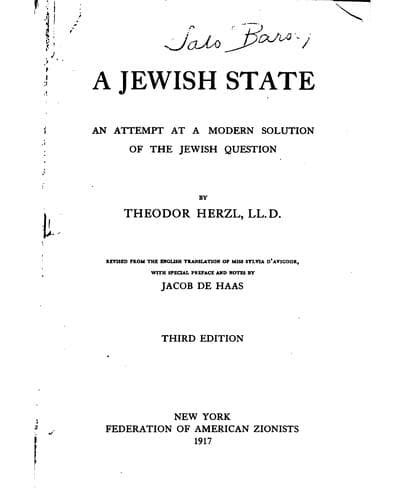
Herzl, Theodor, 1860-1904; Zionism; Zionists -- Austria -- Biography
Whoever would attempt to convert the Jew into a husbandman would be
making an extraordinary mistake. For a peasant is in a historical
category, as proved by his costume which in some countries he has worn
for centuries; and by his tools, which are identical with those used
by his earliest forefathers. His plough is unchanged; he carries the
seed in his apron; mows with the historical scythe, and threshes with
the time-honored flail. But we know that all this can be done by
machinery. The agrarian question is only a question of machinery.
America must conquer Europe, in the same way as large landed
possessions absorb small ones. The peasant is consequently a type
which is in course of extinction. Whenever he is artificially
preserved, it is done on account of the political interests which he
is intended to serve. It is absurd, and indeed impossible, to make
modern peasants on the old pattern. No one is wealthy or powerful
enough to make civilization take a single retrograde step. The mere
preservation of obsolete institutions is a task severe enough to
require the enforcement of all the despotic measures of an
autocratically governed State.
Are we, therefore, to credit Jews who are intelligent with a desire to
become peasants of the old type? One might just as well say to them:
"Here is a cross-bow: now go to war!" What? With a cross-bow, while
the others have rifles and long range guns? Under these circumstances
the Jews are perfectly justified in refusing to stir when people try
to make peasants of them. A cross-bow is a beautiful weapon, which
inspires me with mournful feelings when I have time to devote to them.
But it belongs by rights to a museum.
Now, there certainly are districts to which desperate Jews go out, or
at any rate, are willing to go out and till the soil. And a little
observation shows that these districts--such as the enclave of Hesse
in Germany, and some provinces in Russia--these very districts are the
principal seats of Anti-Semitism.
For the world's reformers, who send the Jews to the plough, forget a
very important person, who has a great deal to say on the matter. This
person is the agriculturist, and the agriculturist is also perfectly
justified. For the tax on land, the risks attached to crops, the
pressure of large proprietors who cheapen labor, and American
competition in particular, combine to make his life hard enough.
Besides, the duties on corn cannot go on increasing indefinitely. Nor
can the manufacturer be allowed to starve; his political influence is,
in fact, in the ascendant, and he must therefore be treated with
additional consideration.
Public-domain text, read in full here on John Shaqi.
Reviews
Reviews
No reviews yet
Be the first to share your thoughts on this work.
Join the Discussion
Join the discussion
Sign in to leave a comment or review.
Sign InorCreate an account