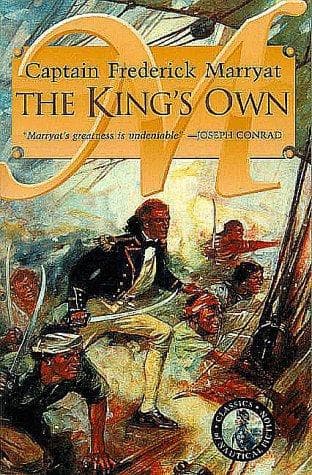
Great Britain -- History, Naval -- 18th century -- Fiction; Nore Mutiny, 1797 -- Fiction
"Granted," replied McElvina; "the more so, as I have often remarked,
that there is no object in the world, except your children or your own
self; in which the _meum_ is so powerful, and the _tuum_ so weak. You
caress your own dog, and kick a strange one; you are pleased with the
clamorous barking of your own cur, and you curse the same noise from
another. The feeling is as powerful, almost, as that of a mother, who
thinks her own ugly cub a cherub compared to others, and its squallings
the music of the spheres. It is because there is no being that
administers so much to the self-love of his master. He submits, with
humility, to the blows inflicted in the moment of irritation, and licks
the hand that corrects. He bears no revengeful feelings, and is ready
to fondle and caress you the moment that your good humour returns. He
is, what man looks in vain for among his kind, a faithful friend,
without contradiction--the _very perfection of a slave_. The abject
submission on his part, which would induce you to despise him, becomes a
merit, when you consider his courage, his fidelity, and his gratitude.
I cannot think what Mahomet was about when he pronounced his fiat
against them, as _unclean_."
"Well," said Debriseau, "I agree with Mahomet that they are _not clean_,
especially puppies. There's that little beast at Monsieur Picardon's, I
declare--"
"Pooh," interrupted McElvina, laughing, "I don't mean it in that sense--
I mean that, in a despotic country, the conduct of a dog towards his
master should be held up as an example for imitation; and I think that
the banner of the Moslem should have borne the dog, instead of the
crescent, as an emblem of blind fidelity and tacit submission."
"That's very true," said Debriseau; "but, nevertheless, I wish
mademoiselle's puppy were either taught manners or thrown over the
quay."
"_Ce n'est pas un chien de sentiment_," replied McElvina, laughing.
"But it is nearly dark. _Allons au cabaret_."
They returned to the inn; and the wind, on the ensuing morning, blowing
strong from a favourable quarter, Willy and Debriseau accompanied
McElvina down to the mole, from whence he embarked on board of the
sloop, which was already under way, and in the course of an hour was out
of sight.
On the following day, Captain Debriseau accompanied Willy to the
_pension_, where our hero remained nearly five months, occasionally
visited by the Guernsey captain, when he returned from his smuggling
trips, and more rarely receiving a letter from McElvina, who had safely
landed his cargo, and was latterly at Havre, superintending the fitting
out of his new vessel. Our hero made good progress during the few
months that he remained at the _pension_, and when McElvina returned to
take him away, not only could speak the French language with fluency,
but had also made considerable progress in what Sir W. C--- used to
designate in his toast as "the three R's,"--viz., "Reading, 'Riting, and
'Rithmetic."
Public-domain text, read in full here on John Shaqi.
Reviews
Reviews
No reviews yet
Be the first to share your thoughts on this work.
Elsewhere in the archive
Join the Discussion
Join the discussion
Sign in to leave a comment or review.
Sign InorCreate an account