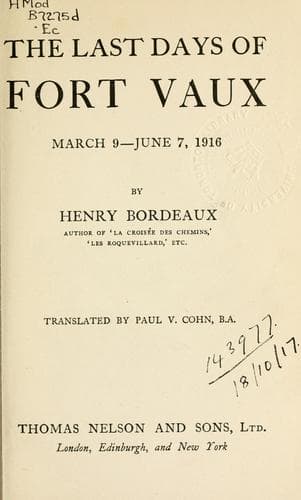
The Last Days of Fort Vaux, March 9-June 7, 1916Bordeaux, Henry
History
The Last Days of Fort Vaux, March 9-June 7, 1916
Bordeaux, Henry
Verdun, Battle of, Verdun, France, 1916; World War, 1914-1918 -- Personal narratives
Towards Froideterre and Souville, the shells as they burst raise dense
pillars of black smoke. In the sky, a fleet of our aeroplanes is coming
back to harbour. The captive balloons complete their observations while
the light lasts. On the rising road there is a never-ending procession
of artillery waggons, travelling field-kitchens, and troops. All this
mass of men and war-material is making for the lines, in order to
deliver stores or to take up positions in a few hours’ time under cover
of darkness.
I stretch myself out on the grass in order to forget this contrast and
merely enjoy the evening air. A little further on there is some one who
has had the same idea as I. He lies at full length, and does not notice
my presence. I should have preferred to be alone. I take another look
at him: his face is one great wound. I go up to him: he is dead. One
does not come here to cut oneself off from one’s fellows and to dream.
Nothing is done here save under the mantle of death.
But with the War, death has lost much of its importance. We have grown
familiar with it. Under the form in which it appears as a rule, not
glorious, not choosing its victims in the full glow of their martial
ardour, but crafty and terrible, in the shape of a mass of iron hurled
from some miles off, it inspires a deep disgust, it is true, but we
submit to it as we submit to an old servant who rules the household. If
we do not rebel against it, if we even consent to accept it, then it
transforms itself after the manner of sorcerers in the old-time fairy
tales. The hideous skeleton is covered with young flesh that has a
fragrance of flowers. The face that it shows is one of dazzling beauty.
The kiss that it gives has something of the affection of France for her
children.
Yes, we have all become reconciled to the idea of death. What is there
left for me if I outlive the War? From my remotest past to the present
moment, all the years that I can take into account stay in my memory
as a little water stays in the hollow of my hand. If I open my fingers,
the water runs away. The past, which seems to me so short, far exceeds
in length all the future that I can anticipate. How trifling a thing,
then, is that future! Death does nothing more than open the fingers of
Time, who bears in his hand our days that are to come. And our days, as
they fall, trickle noiselessly like drops of water.
Public-domain text, read in full here on John Shaqi.
Reviews
Reviews
No reviews yet
Be the first to share your thoughts on this work.
Join the Discussion
Join the discussion
Sign in to leave a comment or review.
Sign InorCreate an account