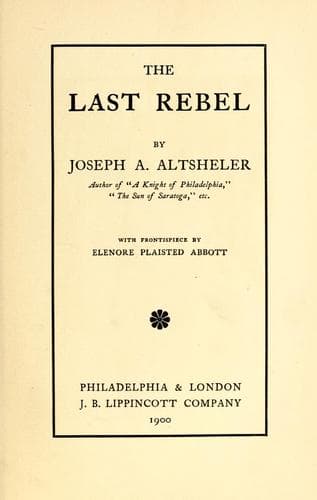
The Last RebelAltsheler, Joseph A. (Joseph Alexander)
History
The Last Rebel
Altsheler, Joseph A. (Joseph Alexander)
Prisoners -- Fiction; United States -- History -- Civil War, 1861-1865 -- Fiction
They agreed that my plan was the only thing feasible, and we called
Miss Hetherill. She was eager to undertake the mission. She had been
waiting to propose it, but held back, expecting us to act first.
She started at once toward the hut, which was only two or three hundred
yards away, but her progress was slow. The snow, which had now attained
a great depth, blocked the way. We watched her breaking her path
through it toward the hut, where the colonel was silent and invisible.
The little building seemed almost crushed under its weight of snow, but
the languid coil of smoke still curled from the mouth of the pipe. Miss
Hetherill was within twenty feet of the door.
"The colonel hasn't taken notice yet," said the doctor. "It would be
funny if she should find him sound asleep and in our power for hours,
if we had only thought to take him."
I watched with eager interest as the twenty feet between Miss
Hetherill and the door diminished. She reached the door and knocked. As
she stood there and waited, I guessed that she received no answer. She
knocked a second time, waited a minute or so, and then pushed the door
open and entered. She ran out again in a moment, uttering a cry and
turning a dismayed face toward us.
We ran to the hut as fast as we could, plunging through the snow. I
was the first to arrive: when I thrust my head in at the open door, I
saw that the place was empty. Some coals still smoldered upon the flat
stone which served for a rude fireplace; a dressed deer-skin lay in the
corner; but the colonel was gone beyond a doubt. One large man would
nearly fill the place.
"He's taken his rifle and ammunition with him," said Crothers, "so he's
all right."
I was glad that he had called attention to the fact so promptly, for it
seemed to indicate deliberation and not delirium on the colonel's part.
There was no need to ask what next from the men about me. Their
obligations to the colonel would never permit them to abandon the
search for him as long as one hope that he was alive existed. But the
great snow was a formidable obstacle to any expedition.
"How shall we go about it?" I asked, hopelessly, of Dr. Ambrose.
"There is no trail," he replied; "the falling snow covers up his
footsteps a half-minute after he makes them; but he must have gone up
that slash through the hills there. It is the easiest route from here,
and the one a man with no fixed idea in his head would most likely
take."
There was a general agreement with the doctor's opinion, and we planned
our pursuit at once. Four men would remain at the camp and protect it,
and relieve us should we return exhausted and without the fugitive.
Miss Hetherill would remain with them. She made some demur, saying she
was a good mountaineer and citing proof, but she yielded to the obvious
fact that a woman could make but little progress through the deep snow.
"We will be sure to bring him back," I said to her when we started.
"Take care of yourself too," she said.
Public-domain text, read in full here on John Shaqi.
Reviews
Reviews
No reviews yet
Be the first to share your thoughts on this work.
Join the Discussion
Join the discussion
Sign in to leave a comment or review.
Sign InorCreate an account