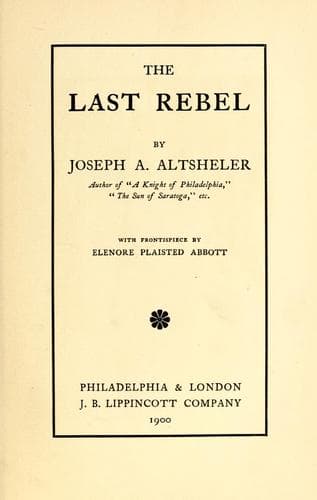
The Last RebelAltsheler, Joseph A. (Joseph Alexander)
History
The Last Rebel
Altsheler, Joseph A. (Joseph Alexander)
Prisoners -- Fiction; United States -- History -- Civil War, 1861-1865 -- Fiction
The snow had ceased and the clouds had gone, leaving a cheerful sun
shining on a white wilderness. We decided to undertake the journey to
Fort Defiance, and our preparations were brief. We had sufficient skill
and material to make a rude litter for the colonel, and we lifted him
gently into it. Then we gathered up our baggage and set out, four men
carrying the litter and relieved at brief intervals by the other sets.
We had to trample a way through the deep snow, and there was plenty of
hard work for us, but we became a cheerful little army. The colonel
was asleep in his litter and seemed to be growing steadily better;
the doctor reported that his pulse was stronger and his fever was
departing. Grace passed from sadness into cheerfulness, almost gayety.
I called her our vivandiere: she replied she was proud of the place.
"You heard what my father said about you in his delirium?" she said,
when we became the last two of the procession. "He would not have
executed you."
"Colonel Hetherill is a fine man, and he has my gratitude," I replied,
not liking to see her under the necessity of excusing him. "He saved
my life a second time. If it hadn't been for him, I'd now be a very
cold corpse at the bottom of a two-hundred-foot precipice, under about
fifteen feet of snow."
"That would have been a chilly tomb," she said, gayly; "but it was not
for you, and we are all thankful."
The weather, it seemed, wished to make some amends for its previous
wickedness. The sun was bright and the air fresh and full of tonic.
Only the snow stood in our way. But we made good progress in spite of
it. At night we devised another rude camp, and took plenty of sleep.
The colonel continued to improve, and his head became quite clear
again. He talked a little, but in a weak tone, and the doctor ordered
him to be silent for his own good. He obeyed like a little child. In
fact, his change in manner and appearance was very striking. He was no
longer the haughty, high-tempered colonel. He was crushed and forlorn.
All the spirit seemed to have gone out of him. It was most pitiful. I
felt sorrier than ever for him, for I knew he looked upon himself as a
defeated man.
We caught the first glimpse of Fort Defiance that afternoon. I saw the
comb of its roof shining like a great white sword-blade in the sun. The
valley, like the mountains, was in garments of white, but the sight of
the houses and fields, under snow though they were, warmed the heart
after the weary tramp among the clefts and peaks.
We descended the slopes and entered the valley. It was my turn to be
one of the four at the colonel's litter. As we swung along at a good
pace, I noticed suddenly that the old man had put his hands to his face
and a tear was dropping between two fingers.
I was silent for a while from respect, but, as he did not take his
hands away, I asked at last, though as quietly as I could,--
"What is the matter, colonel? Do you feel worse?"
Public-domain text, read in full here on John Shaqi.
Reviews
Reviews
No reviews yet
Be the first to share your thoughts on this work.
Elsewhere in the archive
Join the Discussion
Join the discussion
Sign in to leave a comment or review.
Sign InorCreate an account