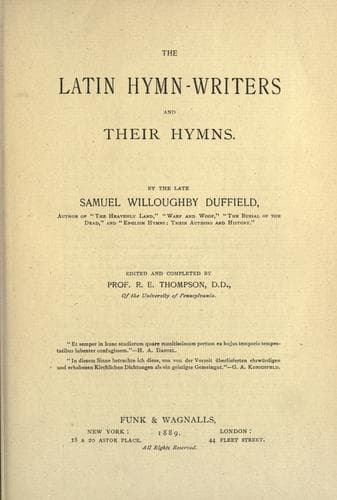
The Latin Hymn-writers and Their HymnsDuffield, Samuel Willoughby
Religion
The Latin Hymn-writers and Their Hymns
Duffield, Samuel Willoughby
Hymns, Latin -- History and criticism
So this hidden current of rhymed and accented poetry of the common
people rose to light again after many ages in the hymns of the Western
Church. Thus Damasus brings us to the parting of the ways. In Hilary,
Ambrose and his school, Prudentius, Ennodius, Fortunatus, Elpis,
Gregory, and Bede we have the perpetuation of the classic tradition of
quantitative verse in the service of Christendom and for the ear of the
cultivated classes. And while that tradition expires in the Middle Ages,
we see it revive again in the sacred poets of the Renaissance—in
Zacharius Ferrari, George Fabricius, Marcus Antonius Muretus, Famiano
Strada and the other revisers of the Roman Breviary, the two Santeuls in
the Breviary of Clugny, and Charles Coffin in the Paris Breviary. But
Damasus stands at the head of a still more illustrious line. Catching,
perhaps, from the Etruscan and Sabine peasants, who thronged the
Catacombs on the day when the Martyr Agatha was commemorated, the
accents of the popular poetry, he became the founder of the tradition
which lives in the broader current of Latin sacred song. In this line of
succession we find already a few of the Ambrosian hymns, and then a long
series in which the two Bernards, Adam of St. Victor, Thomas of Celano,
Thomas Aquinas, and Bonaventura are the most illustrious names. And as
indeed the tradition of accent and rhyme seems to have made its way into
the literature of the modern world through the Latin hymns, Dante and
all the great poets who have illustrated its power to give pleasure
might be said to belong here.
The hymn in commemoration of the Martyr Agatha—whose story of suffering
and triumph had seized on the imagination of the people as did those of
the martyrs Cecilia and Sebastian—we give with the English version of
the Rev. J. Anketell, which he has kindly permitted us to use.
Martyris ecce dies Agathae
Virginis emicat eximiae,
Christus eam Sibi qua sociat,
Et diadema duplex decorat.
Stirpe decens, elegans specie,
Sed magis actibus atque fide:
Terrea prospera nil reputans
Jussa Dei sibi corde ligans.
Fortior haec trucibusque viris
Exposuit sua membra flagris,
Pectore quam fuerit valido
Torta mamilla docet patulo.
Deliciae cui carcer erat,
Pastor ovem Petrus hanc recreat,
Laetior inde magisque flagrans
Cuncta flagella cucurrit ovans.
Ethnica turba rogum fugiens,
Hujus et ipsa meretur opem:
Quos fidei titulus decorat,
His Venerem magis ipsa premat.
Jam renitens quasi sponsa polo,
Pro misero rogitet Damaso,
Sic sua festa coli faciat,
Se celebrantibus ut faveat.
Gloria cum Patre sit Genito,
Spirituique proinde sacro,
Qui Deus unus et omnipotens
Hanc nostri faciat memorem.
Fair as the morn in the deep blushing East,
Dawns the bright day of Saint Agatha’s feast;
Christ who has borne her from labor to rest,
Crowns her as Virgin and Martyr most blest.
Public-domain text, read in full here on John Shaqi.
The Latin Hymn-writers and Their Hymns — John Shaqi
Reviews
Reviews
No reviews yet
Be the first to share your thoughts on this work.
Elsewhere in the archive
Join the Discussion
Join the discussion
Sign in to leave a comment or review.
Sign InorCreate an account