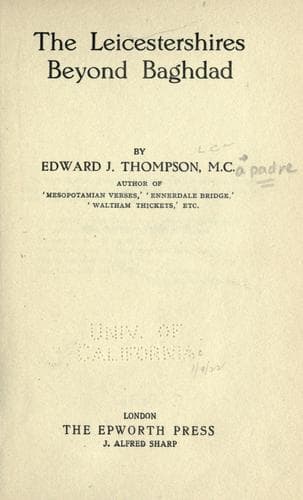
The Leicestershires beyond BaghdadThompson, Edward John
History
The Leicestershires beyond Baghdad
Thompson, Edward John
World War, 1914-1918 -- Campaigns -- Iraq
Once upon a time the river had washed the foot of Al-Ajik ridge. But
now a long stretch of dead ground intervenes before water is reached.
Local legend says a lady lived here who played Hero to a Leander on the
opposite bank. More obviously, Al-Ajik castle guarded Samarra from the
north. The castle is on steep crags, with vast nullas in front. In the
old days it should have been impregnable. Underneath are very large
vaults, filled with rubbish. As our exploring party came up a pair of
hawks left their eyrie, and circled round us, screaming their
indignation. When the division first reached Al-Ajik, Thornhill said, a
pair of Egyptian vultures (Pharaoh's Chickens) were nesting here. These
had gone. They are rare birds in Mesopotamia, and I never saw them
north of Sheikh Saad. Thornhill had seen Brahminy Duck in a nulla, so
we searched till we found a tunnel. Bracken leading, we got in some
hundred yards, stooping and striking matches, till we came on a heap of
bones. Thornhill surmised a hyena, so we returned, as no one wished to
fight even that, unarmed and in a diameter of less than five feet.
There must be many tunnels leading into the heart of Al-Ajik fortress;
and here, as everywhere on the plateau, were remains of the most
complicated irrigation system the ancient world knew. The castle, as it
stands, has been largely built out of the ruined portions on its
northern face.
Life was scant at Samarra, as poor as it had been abundant at
Sannaiyat. The crested larks were of a new species. Owls nested in the
old wells; and most units were presently owning their owlets or
kestrels or speckled kingfishers, miserable-looking birds. Sandgrouse
were few, but commoner towards the central plateau, where were
water-holes. Gazelles were often seen by pickets, and used to break
across the railway-line, to water at the river. One regiment took a
Lewis-gun after them, and other folk chased them in motor-cars. The
British army, as ever, busied itself, as opportunity came, in its
self-appointed task of simplifying the country's fauna that the
naturalist's work might be easier. Wherefore the gazelles left our
precincts, but still haunted the channels of the Dujail, by Beled and
Istabulat. For most of the year the water-holes sufficed them, the
green, velvet dips, with zizyph-bushes fringing each hollow, which
redeem the desert. Hedgehog quills and skins were common, as everywhere
in Mesopotamia. A vast hedgehog led C Company of the Leicestershires
nightly to their picket-stations. On its first appearance a man ran to
bayonet it, but the officer did not see the necessity of this, and
stopped him. So the urchin lived, and ever after paced gravely before
its friends. Then we had the usual birds. Storks nested in the town;
there were rollers and kingfishers, and a hawk or two. But the desert,
with its starved crop of dwarf thorns, had no place for bird or animal.
Men who saw Samarra after my time raved of its winter glory, its
Public-domain text, read in full here on John Shaqi.
Reviews
Reviews
No reviews yet
Be the first to share your thoughts on this work.
Join the Discussion
Join the discussion
Sign in to leave a comment or review.
Sign InorCreate an account