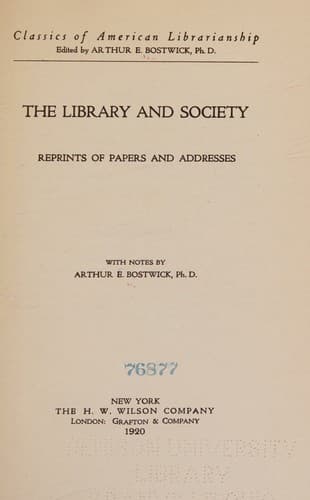
The Library and Society: Reprints of Papers and Addresses
History
The Library and Society: Reprints of Papers and Addresses
Libraries and society; Library science -- Social aspects
Illustrations might be multiplied in educational, religious, and
philanthropic efforts where we work for the masses, and forget that each
one of the mass is a human being with passions, sensibilities,
aspirations like our own. This interest in the human being as such,
which is a gift to some, can be cultivated, but it can never be
simulated. The counterfeit always rings false. Joined to a good memory
for names and faces, it gives a person a power which can hardly be
estimated....
It seems to me that these two principles apply with tremendous and
unusual force to the problems of the modern library. I will speak of the
public library alone because it has a wider reach and a closer touch on
life.
We will review in imagination the library situation in this country. We
take up Mr. Flint's Statistics volume for 1893; we sum up 593 free
libraries in the New England states, 520 in New York, Pennsylvania, and
New Jersey, 285 in the Southern states, 758 in the Western states, a
total of 2156 free libraries.
We recall our friends in the American Library Association, who
constitute with some marked exceptions, who prefer to work alone, the
high-water mark of the fraternity. As their names pass before us we take
a measure of the men and women. We think of their libraries which we may
have visited, or, better still, which we have used as readers. In some
few cases we know the influence of these libraries in the town or city.
Take it for all in all we find a body of hard-working men and women
translating into practice noble ideals. As a result, the library is
beginning to get a hold upon the community. But it is only a beginning
and, compared with the possibilities, only a prophecy of what may and
will be. Are not the failures in our work due to the lack of the best
organization and the true human touch?
A librarian is appointed, let us say, to an important post. He has
doubtless had experience in library work. He comes on to consult with
the trustees. They vote to send him on a trip for getting ideas from
other libraries. He probably has on his hands a beautiful building illy
adapted to library work. He carries the plans with him, and spends most
of the time with other members of the craft, in choosing the least of
several evils in placing the reference-room, catalog, charging-desk,
etc. He secures two or three assistants with training, experience, or
both, and fills the minor places with local help chosen by examination
or by luck or by personal favor. He learns in a general way the
character of the town and selects books with that in view. If there are
certain manufacturing interests or a particular foreign population, he
makes large purchases in those lines. He decides on a system of
classification, of cataloging, and on a method of charging. The books
are rushed through the various processes, though all too slowly for an
impatient public. In a few months at the latest the big educational
plant begins to be utilized.
Public-domain text, read in full here on John Shaqi.
Reviews
Reviews
No reviews yet
Be the first to share your thoughts on this work.
Elsewhere in the archive
Join the Discussion
Join the discussion
Sign in to leave a comment or review.
Sign InorCreate an account