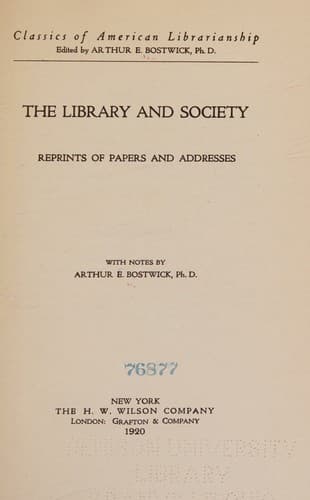
The Library and Society: Reprints of Papers and Addresses
History
The Library and Society: Reprints of Papers and Addresses
Libraries and society; Library science -- Social aspects
This leads us to the first great need of the profession to-day, that the
librarian should be in the noblest sense a large, man, that he should
add to executive and business ability and technical knowledge a broad
and generous culture in Matthew Arnold's sense of the word, "An inward
spiritual activity, having for its character increased sweetness,
increased light, increased life, increased sympathy." He must be an
omnivorous reader, skimming many books, and knowing by instinct which
books and which chapters and sentences to read carefully. He must study
from books and in life the great industrial, social, and religious
questions which stir our age. He must be a scholar without pedantry, a
man of the world without indifference, a friend of the people without
sentimentality.
There follows naturally the second necessity, that the librarian should
be a careful student of his own town. He should know its history and
topography, its social, political, business, literary, and
ecclesiastical life. To this end he should have a personal acquaintance
with the city officers, the party bosses, the labor leaders, members of
the board of trade, manufacturers, leading women in society, with the
clergy, with the school superintendent and the teachers, with those who
shape the charitable organizations, with reporters, policemen, and
reformers.
To what end? Broadly that he may catch the spirit of the civic life and
relate the library to the whole as the organs to the body. Specifically,
that he may reach the entire population through the natural leaders,
that he may select books, establish branches, open up new avenues of
communication between the library and the people.
The church may be aristocratic, industry, trade, and politics a war,
the public school like the drinking-fountain, though planned for the
many scorned by the few. I believe it is possible for a man with a broad
and sympathetic knowledge of our age and an intimate knowledge of his
own city, to make of the public library the one common meeting-place,
the real focus of democratic ideas. The church and the school will reach
this in the future, the library may achieve it to-day.
Public-domain text, read in full here on John Shaqi.
Reviews
Reviews
No reviews yet
Be the first to share your thoughts on this work.
Elsewhere in the archive
Join the Discussion
Join the discussion
Sign in to leave a comment or review.
Sign InorCreate an account