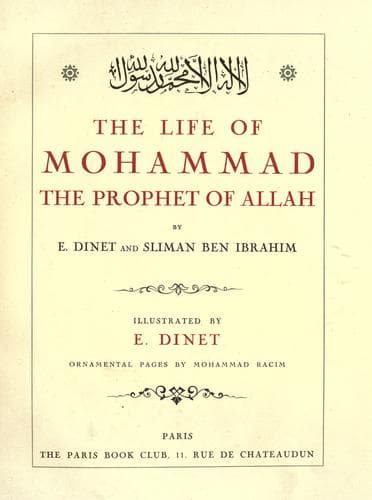
The Life of Mohammad, the Prophet of AllahDinet, Etienne
Religion
The Life of Mohammad, the Prophet of Allah
Dinet, Etienne
Muhammad, Prophet, -632
These persecutions continued notwithstanding, becoming more and more
barbarous. The Banu Makhzum tribe took Ammar, with Yaser, his father,
and Summayy, his mother, out on the Ramda, in order to make them
suffer all the tortures prompted by diabolical ferocity. Ammar was
enclosed in an iron breastplate that held him down on the ground,
exposed to the blazing rays of the sun at its zenith. His flesh
crackled as if in contact with molten metal. But the same thing
happened as with Bilal; the idolaters were unable to drag from Ammar
or his parents, tortured in like fashion, one blasphemous word. It was
then that, blinded by rage, Abu Jahal drove his spear through
Summayy's heart, mocking the dying woman by telling her: 'If thou dost
believe in Mohammad, 'tis because thou art in love with his beauty!'
Summayy was the first martyr to Islam, but such constancy was not to
be found in all. A few Believers, enfeebled by privation and torture
to such an extent that they could not stand upright, finished by
letting fall from their lips, despite themselves, the blasphemous
utterances ensuring release. For such as these, crushed by shame and
shedding tears of repentance, the following Surah of consolation has
come down: "_Whoso after he hath believed in God, denieth Him, if he
were forced to it and if his heart remain steadfast in the faith
(shall be guiltless:) * But whoso openeth his breast to infidelity--on
them in that case shall be wrath from God, and a severe punishment
awaiteth them._" (THE QUR'AN, XVI, 108).
When the Prophet saw what tortures were inflicted on his disciples and
that he was powerless to protect them, he was overwhelmed with intense
sadness. The martyrs' courage proved to him how deeply the roots of
faith were planted in their hearts; nevertheless he considered that
such sacrifices should be avoided. So he advised all who were weak, or
even such as were not forced by imperious necessity to remain in
Makkah, to emigrate to Abyssinia, a land inhabited by Christians,
whose Chieftain, the Najashi (Negus) was celebrated for his tolerance
and justice.
[Sidenote: THE EMIGRATION TO ABYSSINIA (_A.D. 615_)]
Sixteen Moslems were the first to depart. Among them was Usman ibn
Affan and his wife Ruqaiyah, one of the Prophet's daughters. They went
out from Makkah secretly and on foot. Reaching the shore of the Red
Sea, they chartered a _felucca_ which carried them over to the
opposite bank, from whence they journeyed to the Court of the Najashi
who welcomed them kindly. Another caravan soon joined them, and the
little Mussulman colony, having taken refuge in Abyssinian territory,
was made up of eighty-three men and eighteen women.
Public-domain text, read in full here on John Shaqi.
Reviews
Reviews
No reviews yet
Be the first to share your thoughts on this work.
Join the Discussion
Join the discussion
Sign in to leave a comment or review.
Sign InorCreate an account