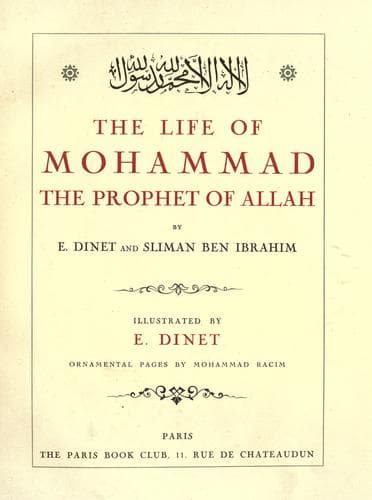
The Life of Mohammad, the Prophet of AllahDinet, Etienne
Religion
The Life of Mohammad, the Prophet of Allah
Dinet, Etienne
Muhammad, Prophet, -632
It seemed as if Islam was henceforward to soar aloft safely, when two
events suddenly caused its wings to be clipped. First came the death
of Abu Talib, its indefatigable protector, who had passed the age of
eighty.
We have already mentioned that, despite all his sympathy for Islam,
Abu Talib had never consented to profess it. Abu Talib, in his dying
moments, having advised all present to obey Mohammad in everything,
for he was sure to lead them into the Path of Righteousness, the
Prophet risked a supreme effort. 'O my uncle!' said Mohammad, 'thou
dost soothe their souls with wise counsel, but wilt thou do nothing
for thine own?'--'What wouldst have me do?'--'Bear witness simply that
there is no Allah but Allah!--'O son of my brother! I know that thou
dost speak truly, but I fear to be accused of only testifying in
affright at the approach of death. Were it not for this fear, be
assured that I would follow thy advice, in order to freshen thine eyes
in which I read the high degree of thy affection.'
Some writers maintain that Abbas, seeing the dying man's lips move,
and having placed his ear close to them, made the following
declaration to the Prophet: 'Be not uneasy, O son of my brother! thy
uncle hath just uttered the words thou didst wish him to say.' But the
most accredited traditions refuse to accept this version. Where is the
truth? Allah only knows!
Three days after this bereavement, fraught with fatal consequences,
the Prophet had to put up with a still more grievous loss.
Khadijah, his admirable companion, who gave herself to him when he was
poor and had believed in him when he was called an impostor; Khadijah,
to whom he confided all his hopes; Khadijah, the sweet consoling
creature when he was crushed by the weight of despair; Khadijah, the
first female Moslem, the "Mother of the Believers," was taken from him
by the Fates at the age of sixty-five. (May Allah welcome her in His
Grace!)
Khadijah's ascendancy over him was so great and yet so tender that
while she lived, he had never been unfaithful. Never, although he was
then in the prime of life, would he consent to have other wives or
concubines, as permitted by the customs of his country, in spite of
being invited on all sides to do so. And never, when Khadijah was no
more, did he forget her.
Ayishah, who later on became Mohammad's favourite spouse, was keenly
jealous of the remembrance of his first wife, daily evoked by him.
"Never was I so jealous of any wife of the Prophet as of Khadijah,"
Ayishah is known to have said, "although I never met her and
notwithstanding that her death took place long before my marriage. But
the Prophet was always talking about her, and when he slaughtered a
sheep, he always kept back a liberal share to be given to Khadijah's
female friends.
Public-domain text, read in full here on John Shaqi.
Reviews
Reviews
No reviews yet
Be the first to share your thoughts on this work.
Elsewhere in the archive
Join the Discussion
Join the discussion
Sign in to leave a comment or review.
Sign InorCreate an account