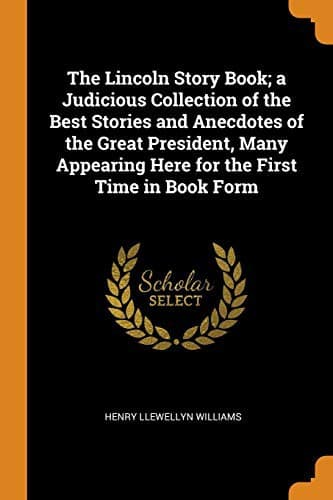
The Lincoln Story Book: A Judicious Collection of the Best Stories and Anecdotes of the Great President, Many Appearing Here for the First Time in Book Form
History
The Lincoln Story Book: A Judicious Collection of the Best Stories and Anecdotes of the Great President, Many Appearing Here for the First Time in Book Form
Lincoln, Abraham, 1809-1865 -- Anecdotes
"Gentlemen, fellow citizens: I presume you all know who I am. I am
humble Abraham Lincoln. I have been solicited by my friends to become a
candidate for the legislature. My politics are short and sweet--like an
old woman's dance! I am in favor of a national bank, the international
improvement scheme, and a high protective tariff. These are my
sentiments and political principles. If elected, I will be thankful. If
defeated, it will be all the same!"--(Springfield _Republican_.)
* * * * *
A LIGHTNING-ROD TO PROTECT A GUILTY CONSCIENCE!
One term in the Illinois State legislature only whetted the predestined
politician for a seat again at that table, though it was not he who won
the loaves and the fishes. He was to speak at Springfield, the more
gloriously welcomed as he was prominent in the movement hereafter
realized, of changing the capital from Vandalia to this more energetic
town.
The meeting had foreboded ill, as a serious wrangle between two of the
preceding speakers threatened to end in a challenge to a duel, still a
fashionable diversion. But Lincoln intervened with a speech so
enthralling that the hearers forgot the dispute and heard him out with
rapture. He had found the proper way to manage his voice, never
musical, by controlling the nasal twang into a monotonous but audible
sharpness, "carrying" to a great distance. He was followed by one
George Forquer (Farquhar or Forquier), a facing-both-ways,
profit-taking politician, who had achieved his end by obtaining an
office. This was the land-office register at this town. He had been a
prominent Whig representative in 1834. The turncoat assailed Lincoln
bitterly (much as Pitt was derided in his beginning) and had begun his
piece by announcing that "the young man (Lincoln) must be taken down."
As if to live up to the lucrative berth, Mr. Forquer had finished a
frame-house--Springfield still had log houses, and not only in the
environs, either!--and to cap the novelty, had that other new feature,
a lightning-rod, put upon it. The object of the slur at youth had
listened to the diatribe, flattering only so far as he was singled out.
Mr. Joshua F. Speed, a bosom friend of Lincoln, reports the retort as
follows:
"The gentleman says that 'this young man must be taken down.' It is for
you, not for me, to say whether I am up or down. The gentleman has
alluded to my being a young man; I am older in years than in the tricks
and trades of politicians.
"I desire to live, and I desire place and distinction as a politician;
but I would rather die now than, like the gentleman, live to see the
day that I would have to erect a lightning-rod to protect a guilty
conscience from an offended God!"
Mr. Speed says that the reply was characterized by great force and
dignity. The happy image of the lightning-rod for a conscience has
passed into the fixed-star stage of a household word throughout the
West.
* * * * *
Public-domain text, read in full here on John Shaqi.
Reviews
Reviews
No reviews yet
Be the first to share your thoughts on this work.
Join the Discussion
Join the discussion
Sign in to leave a comment or review.
Sign InorCreate an account