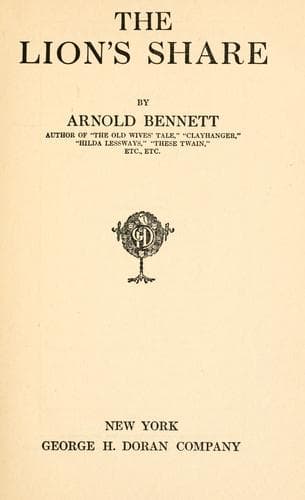
England -- Fiction; Man-woman relationships -- Fiction; Mothers and daughters -- Fiction; Paris (France) -- Fiction; Women -- Fiction
Audrey was in a white piqué coat and short skirt, with pale blue blouse and
pale blue hat--and at the extremity blue stockings and white tennis shoes.
She picked up a tennis racket in its press, and prepared to leave the
studio. She had bought the coat, the skirt, the blouse, the hat, the
tennis shoes, the racket, the press, and practically all she wore, visible
and invisible, at that very convenient and immense shop, the Bon Marché,
whose only drawback was that it was always full. Everybody in the Quarter,
except a few dolls not in earnest, bought everything at the Bon Marché,
because the Bon Marché was so comprehensive and so reliable. If you desired
a toothbrush, the Bon Marché not only supplied it, but delivered it in a
30-h.p. motor-van manned by two officials in uniform. And if you desired a
bedroom suite, a pair of corsets, a box of pastels, an anthracite stove, or
a new wallpaper, the Bon Marché would never shake its head.
And Audrey was now of the Quarter. Many simple sojourners in the Quarter
tried to imply the Latin Quarter when they said the Quarter. But the
Quarter was only the Montparnasse Quarter. Nevertheless, it sufficed. It
had its own boulevards, restaurants, cafés, concerts, theatres, palaces,
shops, gardens, museums, and churches. There was no need to leave it, and
if you were a proper amateur of the Quarter, you never did leave it save to
scoff at other Quarters. Sometimes you fringed the Latin Quarter in the big
cafés of the Boulevard St. Michel, and sometimes you strolled northwards as
far as the Seine, and occasionally even crossed the Seine in order to enter
the Louvre, which lined the other bank, but you did not go any farther. Why
should you?
Audrey had become so acclimatised to the Quarter that Miss Nickall's studio
seemed her natural home. It was very typically a woman's studio of the
Quarter. About thirty feet each way and fourteen feet high, with certain
irregularities of shape, it was divided into corners. There were the two
bed-corners, which were lounge-corners during the day; the afternoon-tea
corner, with a piece or two of antique furniture and some old silk
hangings, where on high afternoons tea was given to droves of visitors; and
there was the culinary corner, with spirit-lamps, gas-rings, kettles, and a
bowl or two over which you might spend a couple of arduous hours in
ineffectually whipping up a mayonnaise for an impromptu lunch. Artistic
operations were carried out in the middle of the studio, not too far from
the stove, which never went out from November to May. A large mirror hung
paramount on one wall. The remaining spaces of the studio were filled with
old easels, canvases, old frames, old costumes and multifarious other
properties for pictures, trunks, lamps, boards, tables, and bric-à-brac
bought at the Ham-and-Old-Iron Fair. There were a million objects in the
studio, and their situations had to be, and were, learnt off by heart. The
scene of the toilette was a small attached chamber.
Public-domain text, read in full here on John Shaqi.
Reviews
Reviews
No reviews yet
Be the first to share your thoughts on this work.
Elsewhere in the archive
Join the Discussion
Join the discussion
Sign in to leave a comment or review.
Sign InorCreate an account