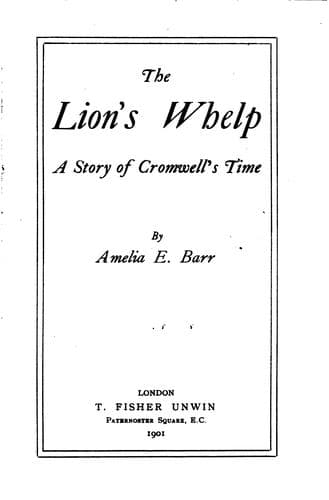
The Lion's Whelp: A Story of Cromwell's TimeBarr, Amelia E.
History
The Lion's Whelp: A Story of Cromwell's Time
Barr, Amelia E.
Great Britain -- History -- Stuarts, 1603-1714 -- Fiction
"We had been at work all day, but at that hour we had two bridges over
the Severn, and Cromwell with half the army passed over them to the west
side of the city. He rode in front, and was the first man to cross.
Pitscottie’s Highlandmen were waiting for him, and he drove them at push
of pike from hedge to hedge till they were cut to pieces, every man’s
son of them, one on the heels of the other. And when Charles Stuart saw
this battle raging on the west side of the river, he attacked the troops
that had been left with Lambert on the east side. Right glad was
Lambert, and ’tis said that the Stuart behaved very gallantly and broke
a regiment of militia; and the troops, being mostly volunteers, began to
waver. But Cromwell saw this new attack at once, and he and Desborough
and Cobbett came rattling over the bridges of boats. No dismay when
Cromwell was there! His voice and presence meant victory! The
malignants, with their Scotch allies, retreated before him into
Worcester streets, Cromwell’s men after them pell-mell. Women, it was
then hell let loose, for by this time it was nearly dark, and the narrow
streets were lit only by the flashes of the great and small shot.
Cromwell rode up and down them, in the midst of the fire; he took Fort
Royal from the enemy, and with his own hands fired its guns upon them as
they fled hither and thither, they knew not, in their terror and
despair, where. Every street in Worcester was full of fire and blood,
the rattle of artillery, the shouts of our captains, the shrieks of the
dying. All night the sack of the city went on. It was a tenfold
Drogheda, and ever since, by day and night, Lambert has been following
the flying enemy, hunting and slaying them in every highway and
hiding-place. Oh, indeed, the faces of our foes have been brought down
to earth and their mouths filled with dust; and rightly so. No one will
ever know the number slain, and we have ten thousand prisoners."
"Was such cruelty necessary?" asked Mrs. Swaffham.
"War is cruel, Martha; a battle would not be a battle unless it was
cruel—furiously cruel. What is the use of striking soft in battle? The
work is to do over again. A cruel war is in the end a merciful war."
"It is said Charles Stuart is slain."
"I don’t believe that report, it has been spread by his friends to
favour his escape. At first he was distracted, and went about asking
some one to slay him; but he was seen afterwards beyond the gates of
Worcester, moving eastward with a number of his adherents. David Leslie
may be slain. I saw him riding slowly up and down like a man who had
lost his senses. I could have shot him easily—but I did not."
"Thank God, Doctor!"
Public-domain text, read in full here on John Shaqi.
Reviews
Reviews
No reviews yet
Be the first to share your thoughts on this work.
Join the Discussion
Join the discussion
Sign in to leave a comment or review.
Sign InorCreate an account