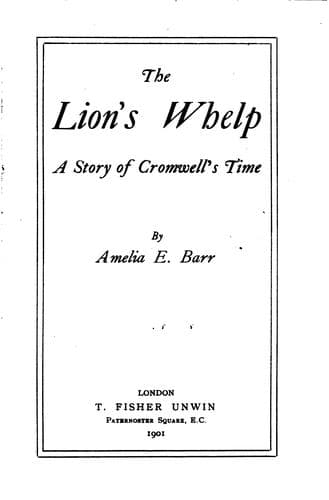
The Lion's Whelp: A Story of Cromwell's TimeBarr, Amelia E.
History
The Lion's Whelp: A Story of Cromwell's Time
Barr, Amelia E.
Great Britain -- History -- Stuarts, 1603-1714 -- Fiction
and when she had got thus far, a loud, joyful voice joined her in the
next two lines, and its owner came into the room singing them—
"Thou art our Castle of defense,
Our Fort, our Bulwark and our Shield."
"Oh, Doctor Verity!" Jane cried, "how glad I am to see you."
"I had been here an hour ago, but I had to wait on the Lady Mary
Cromwell. They who serve women must learn to wait. She has sent you a
letter, and a coach is at your order, and you are bid to Whitehall. And
you will be very welcome there."
"I know not any ceremonies, Doctor."
"You do not need to know them. It is Mary Cromwell, yet; though if the
women of Cromwell’s house assume greatness, he has won it for them. Why
should they not wear the honours their father gives them?"
Then Jane ran to her mother, and her box of fineries was quickly packed,
and the girl came down for her visit glowing with hope and happiness.
All the shadows were gone; she sat a little proudly in the fine coach by
the side of Doctor Verity, and was alert and watchful, for it did not
seem an improbable thing that she might have a passing sight of her
lover. The city had by this time recovered its every-day temper, and
she could not help contrasting the plodding, busy serenity of its
present mood with its frenzy of triumphant joy on the entry of Cromwell.
Doctor Verity insisted that the two conditions were alike natural. "No
one can play the fool like a wise man," he said; "and the greater and
the richer the city the more extravagantly and unreasonably and
vauntingly it will express its victory and salvation. London had so
much to lose," he continued, "that it would better have lain in ashes
than lain at the feet of any Stuart."
As they drew near to Whitehall, Jane’s spirits fell a little. She had
not caught a glimpse of her lover, and she felt a sudden anxiety about
her position. Sometimes prosperity is as fatal to friendship as
adversity, and the girl tried in silence to prepare herself for any
change in affection that change of fortune might have caused. But her
fears were very transient; Mary and Frances Cromwell met her with
effusive attentions; they called her affectionately by her name, and
quickly took her to the general sitting-room of the family. Madame
Cromwell was there, as kind and motherly as of old; and Mistress Ireton,
silently reading a sermon of Doctor Owen’s; and Mrs. Claypole selecting
some damask for a new gown; and Mary and Frances, full of the joy and
pride of their great position, soon carried Jane all through their
splendid apartments, and afterwards sat down together in Mary’s room to
talk over old times and the friends and occupations that had made them
happy and memorable. Their first inquiry was for Lady Matilda de Wick,
and when Jane answered, "Her father is dead, and I know not exactly what
has befallen her since his death," the girls were all silent a few
minutes. After the pause, Mary Cromwell said—
Public-domain text, read in full here on John Shaqi.
Reviews
Reviews
No reviews yet
Be the first to share your thoughts on this work.
Elsewhere in the archive
Join the Discussion
Join the discussion
Sign in to leave a comment or review.
Sign InorCreate an account