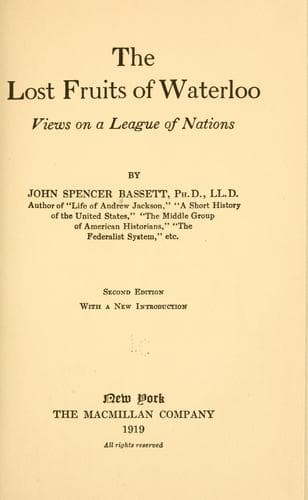
International cooperation; Peace; World War, 1914-1918
During this period Théophile Delcassé was head of the French foreign
office (1898-1905). He was a man of great original ability and was
desirous of restoring the prestige of France. When he came into office
the French public was excited over the Fashoda incident, a clash of
French and British interests in the Sudan which seemed to threaten
war. The British government took a strong attitude, as it was likely
at that time to do, when it felt that it was dealing with a weaker
nation. Delcassé realized that the true welfare of his country demanded
friendship with the one power which could help it against Germany, and
at the risk of denunciation at home he gave up all that Great Britain
demanded in the Sudan. He thus showed that he possessed that high trait
of statesmanship which consists in the ability to convert an opponent
into a firm friend.
The opportunity to which he was looking forward came when Germany set
her plans into operation during the Boer war. He not only held out for
the return of the lost provinces but, that failing, made overtures for
a better understanding with the British. It was a time when a friendly
hand was gladly received by the London government. The result was a
series of agreements which became known as the _Entente Cordiale_,
1904. They marked the reappearance of Great Britain as a leading power
in Continental affairs, after a long period of aloofness. She had
become an active part of the Balance of Power, and her strength was
thrown to the side which was bent on restraining the vast influence
of Germany. Her action caused great alarm at Berlin, where her motive
was interpreted as commercial jealousy, the statesmen of that city
apparently forgetting that they had provoked it by their unfriendly
attitude in the Boer war.
In the same year began the Russo-Japanese war (1904-1905). At first
glance it would seem that this conflict threatened to weaken the
_Entente Cordiale_, for Japan was allied to Great Britain and Russia
was bound up with France by the Dual Alliance. But the result was
just the opposite. The _Entente_ was not only left intact, but it was
actually strengthened. When Japan defeated Russia, Great Britain ceased
to fear Russian aggression in the Far East, which made it possible for
her to draw nearer to the Muscovite power. At the same time, Russia,
always seeking an outlet to the sea, turned her eyes with greater
eagerness than ever to the Near East, which brought her into a more
intense state of opposition to Austria and Germany. Delcassé seized
the opportunity offered him and succeeded in bringing together these
two great nations, which for many years had been continually ready to
fly at one another. He put into motion the negotiations out of which
was formed the Triple _Entente_ (1907) in which Great Britain, France,
and Russia announced that they had settled their differences and would
stand together in future crises.
Public-domain text, read in full here on John Shaqi.
Reviews
Reviews
No reviews yet
Be the first to share your thoughts on this work.
Elsewhere in the archive
Join the Discussion
Join the discussion
Sign in to leave a comment or review.
Sign InorCreate an account