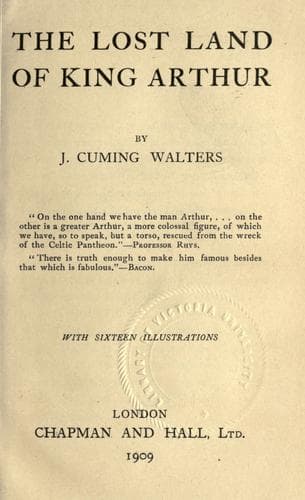
Arthur, King -- Homes and haunts -- England -- Cornwall (County); Cornwall (England : County) -- Antiquities, Celtic
Everything is past but the names of men and places--names that we have
and ideals that we make. A ford with Arthur’s name, a stone associated
with his deeds, a city where his temples were reared! Tranquilly flows
the river and washes the unfrequented banks; and Caerleon-upon-Usk,
like a wave that has been spent and dies upon the shore, has ebbed into
the quietude of tideless time and has been lost. Yet, to him who goes
with open mind and simple faith, Caerleon is even now a wonderland, and
fragments of its marvellous story are scattered on the roadside, in
the undulating meadows, and along the banks of the wide brown river.
Everywhere we find remnants of a remarkable past; and though the city
has dwindled to a hamlet and is sequestered from the busy toiling
world, it seems like the city of fable which slept until the promised
prince came and released it from the fetters of enchantment. So may
Caerleon one day be awakened.
The healing sun-god, Belenus (from whose name our modern Billingsgate
is derived), was the Celtic Apollo, and to him is ascribed the
foundation of Caerleon. Others, with better reason, ascribe it to
Lleon, an ancient British king. The Romans, about the year 70 A.D.,
made it one of their chief stations in Britannia Secunda, and the
city in their time is reputed to have been nine miles in area. Akeman
Street went from it to Cirencester, and the maritime Julian Way passed
through it from Bath to Neath, while the mountain Julian Way connected
it with Abergavenny. Fragments of a Roman fortress 12 feet thick and
1,800 yards in circuit have been found, and the Roman amphitheatre, 16
feet high and 222 feet by 192 feet in extent, is popularly known as
the festival scene of King Arthur and his knights. Some of the Roman
bricks and tiles are to be found in the modern structures, and part of
the old Roman wall twelve feet high is still visible. In the days of
Hadrian the best part of the city was Caerleon _ultra pontem_--that
part lying beyond the wooden movable bridge, which is now replaced
by one of stone.[19] The local museum is crowded with memorials
of antiquity--tesselated pavements, Roman stones and inscriptions,
baths, altars, sculpture, Roman lamps (found in a road cutting), glass
vessels, bronze ornaments, harness buckles, keys, coins, and stone
facings of the rooms in the Castle Villa. Most curious and valuable
of all, perhaps, is a boundary stone showing that the sea-walls were
the work of the third-century Romans and made by their soldiery. But
the sea has receded from Caerleon and is now quite two miles away, and
Newport has arisen where once the ships of Caerleon sailed. All the
Roman temples which King Arthur found in the city he is said to have
converted into Christian churches, St. Dubric, the most famous of the
ecclesiastics of antiquity, being appointed the archbishop. On the
other hand, the archbishopric is said to date from 182, and to have
lasted until 521. But the remarkable and significant fact is that while
Public-domain text, read in full here on John Shaqi.
Reviews
Reviews
No reviews yet
Be the first to share your thoughts on this work.
Elsewhere in the archive
Join the Discussion
Join the discussion
Sign in to leave a comment or review.
Sign InorCreate an account