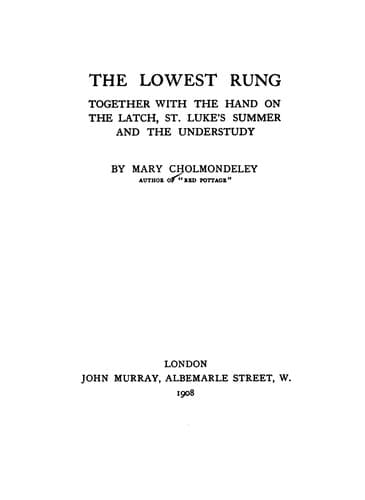
The Lowest Rung: Together with The Hand on the Latch, St. Luke's Summer and The UnderstudyCholmondeley, Mary
General
The Lowest Rung: Together with The Hand on the Latch, St. Luke's Summer and The Understudy
Cholmondeley, Mary
Short stories, English
The following year I suddenly married a soldier, the only young man I
knew, and I knew him very slightly, and went out to India with him. I
did not forget Aunt Emmy, we corresponded regularly; but I was young
and my life was a very full one. I had seen nothing of the world till I
married. I had a child. The years rushed past, joyful, miserable, vivid,
surprising, happy years, in spite of the fact that my husband was not
remarkably like Lord K----in appearance, and not in the least like the
"plaister saint" with whom I had hurried to the altar on such slight
provocation.
During these years Uncle Thomas died, and Uncle Tom married, and Aunt
Emmy wrote to me that she had taken a little cottage in Abinger Forest
against her brother's advice, and how, in spite of his opposition--how
much it must have cost her to oppose him--he had forgiven her and
presented her with the most expensive mahogany bedstead and bedding that
Maple could supply--"so like him."
I wondered vaguely once or twice whether there had been any question of
her marrying Mr. Kingston, but there was no mention of him in her
letters, and I did not like to ask. I knew that she was very poor, but
presently my heart was gladdened by hearing from her that a distant
relation had left her a legacy, and that she was now comfortably off.
Then suddenly our life was darkened. Our child died. I struggled with
my grief, became ill, and was sent home. Aunt Emmy urged me to go
straight to her. She and Uncle Tom were my only near relations in
England. He also offered to take me in for a time. He wrote with real
kindness. He had a child himself. And his wife wrote too. But I need
hardly say that I took my sore heart and my broken health straight to
Aunt Emmy.
It was late in August when I arrived. The honeysuckle was still in bloom
on Aunt Emmy's white cottage, standing in its little orchard in a
clearing in the forest. She was waiting for me in the porch, and I ran
feebly to her up the narrow brick path between the tall clumps of
hollyhocks and Michaelmas daisies; and she drew me into the little
parlour and held me closely to her. And the years rolled away, and I was
a child again, and she was comforting me for my broken doll.
With the egotism of youth I fear I had not given a thought to Aunt
Emmy's new home until I entered it. I knew that she was happy in it, and
that it had once been a gamekeeper's cottage, but that was about all.
Nowadays every one has a cottage--it is the fashion; and literary men
and women, tired of adulatory crowds, weary of their own greatness, flee
from the metropolis, and write exquisite articles about their gardens,
and the peace that lurks under a thatched roof, and the simple life,
lived far from shrilling crowds but near to nature, and _very_ near to
the Deity. Fortunate Deity!
But in the days of which I am writing cottages and their floral and
spiritual appurtenances were not the rage.
Public-domain text, read in full here on John Shaqi.
Reviews
Reviews
No reviews yet
Be the first to share your thoughts on this work.
Join the Discussion
Join the discussion
Sign in to leave a comment or review.
Sign InorCreate an account