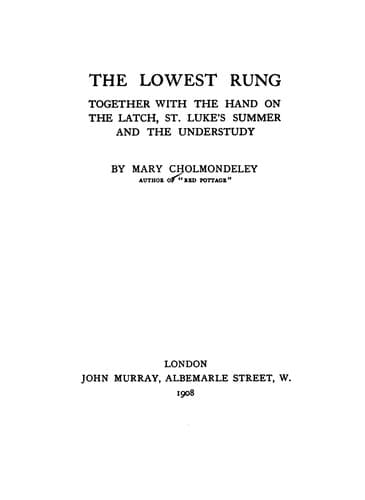
The Lowest Rung: Together with The Hand on the Latch, St. Luke's Summer and The UnderstudyCholmondeley, Mary
General
The Lowest Rung: Together with The Hand on the Latch, St. Luke's Summer and The Understudy
Cholmondeley, Mary
Short stories, English
Marion Wright sat in the centre seat of the third row of the stalls,
shivering in spite of her sables. It was the dress rehearsal of her
first play, that play on which she had spent herself to the verge of
mental bankruptcy.
The nauseating presentiment of failure, the distaste and scorn of her
own work, were upon her, which the artist never escapes, which return as
acutely after twenty successes as in the hours of suspense before the
first essay. Marion's surroundings were not of a nature to reassure her.
To her unaccustomed eyes the empty, dimly lit theatre, swathed and
bandaged in dust-sheets, looked ominously dreary. Had any one ever
laughed in this shrouded desert? The long lines of stalls huddled under
their wrinkled coverings stretched before and behind her. The boxes were
shapeless holes of pallid grime. It was as if a London fog had trailed
its dingy veil over everything. There was a fog outside as well, and the
few electric lights which had been turned up peered blurred and yellow.
An immense ladder, three ladders tied together, reared itself from the
stalls to the roof. Something was being done to the lights on the
ceiling. Tired-looking men in overcoats were creeping into the
orchestra, thrusting white faces under screened lights, and rustling
papers on stands.
Marion had the theatre to herself except for a few whisperers in the
back row of the stalls--her maid, an attendant, one or two actors of
minor parts who did not appear in the first act, and a few costumiers.
It was fiercely cold, and she had not slept for several nights. She
wished she had never been born.
A magnificent-looking woman, wearing her chin tilted slightly upwards,
was squeezing herself and an immense fur coat towards her along the
stalls, and sat down beside her. This was Lenore, the leading lady.
She turned a colourless, beautifully shaped face and heavy eyes with
bistred lashes towards Marion.
"I suppose we shall have to wait about two hours for Mr. Montgomery,"
she said apathetically.
"Does he always keep people waiting?"
"Always, since he made his great hit in _The Deodars_."
There was a moment's silence.
"Mr. Montgomery does not like his part," said the leading lady
tentatively, hanging a hand in an interminable white glove over the back
of the stall in front of her.
Marion's face hardened.
"It's not a sympathetic part," she said, "but an artist ought not to
think of that."
"No, it's not sympathetic," acquiesced Lenore, turning up her fur
collar. "It seems as if the principal man's part never _is_ sympathetic
in a woman's play. If the central figure is a woman, the men grouped
round her are generally prize specimens of worms. I wonder why. In your
play, now, Maggie's everything! George does not count for much, as far
as I can see. Even Maggie had not much use for him."
"She loved him," said the author, with asperity.
Public-domain text, read in full here on John Shaqi.
Reviews
Reviews
No reviews yet
Be the first to share your thoughts on this work.
Elsewhere in the archive
Join the Discussion
Join the discussion
Sign in to leave a comment or review.
Sign InorCreate an account