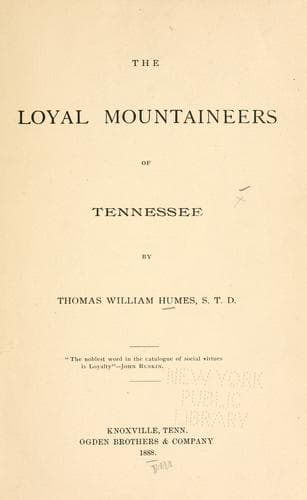
The loyal mountaineers of TennesseeHumes, Thomas William
Philosophy
The loyal mountaineers of Tennessee
Humes, Thomas William
Tennessee, East -- History -- Civil War, 1861-1865
“Submit yourselves to every ordinance of man for the Lord’s sake:
whether it be to the king as supreme; or unto governors, as unto them
that are sent by him for the punishment of evil doers, and for the
praise of them that do well. For so is the will of God.”
Aiming to promote a spirit of order and peace, the minister who
conducted these religious services at Knoxville preached that morning
upon the importance of right government and obedience to it--of using
freedom, not in the service of evil passions, but of neighborly, kind
affections, from the apposite words:
“For, brethren, ye have been called unto liberty; only use not
liberty for an occasion to the flesh, but by love serve one another.”
As if, however, the hour for discord had come, and its footsteps
would not tarry, the result of the day was the loss to the church of
several leading families whose sympathies were strongly with “the
South,” including that of a church warden. He was a worthy citizen
and sincere christian, but he “could no longer attend as a worshipper
and listen to the ‘prayer for the President of the United States and
all in authority,’” as set forth in the Book of Common Prayer. The
prayer dates back to the year 1789.
The agitations and mutual wrath of parties at the locality, each
of them being strong, were sensibly increased by the secession
of Virginia and the forcible seizures of Harper’s Ferry and the
Portsmouth Navy Yard, which followed not long after the Baltimore
fight. Notwithstanding the people of Tennessee had voted against
secession in February, 1861, by a majority of 60,000, now, in the
absence of any later expression of their will on the subject through
an authorized channel, the State Government entered into a military
league with the Southern Confederacy and passed an ordinance of
secession subject to the ratification of the people at the polls on
the eighth of June. Under that league troops were enlisted throughout
the State, and so without having seceded or become a member of the
Confederacy, Tennessee was placed independently in actual rebellion
against the United States. Some eight hundred of these soldiers were
stationed in camp near Knoxville. One day Andrew Johnson and Thomas
A. R. Nelson addressed the people on the principal business street
of the town, the court-room being too small to receive them. The
meeting was disturbed by the loud music of a Confederate band from
a neighboring hotel, and by the threatening demeanor of armed men
who had just been addressed by secession orators and were parading
the streets. A bloody collision was only prevented by the friendly
interposition of peaceably disposed men from both parties. The same
two Union leaders were soon afterwards stopped in addressing the
people at Blountville in the strong Democratic county of Sullivan,
and compelled to desist.
Public-domain text, read in full here on John Shaqi.
Reviews
Reviews
No reviews yet
Be the first to share your thoughts on this work.
Join the Discussion
Join the discussion
Sign in to leave a comment or review.
Sign InorCreate an account