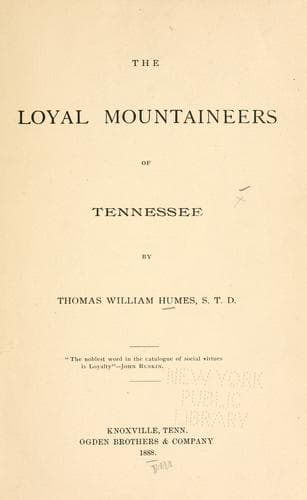
The loyal mountaineers of TennesseeHumes, Thomas William
Philosophy
The loyal mountaineers of Tennessee
Humes, Thomas William
Tennessee, East -- History -- Civil War, 1861-1865
The material interests which were affirmed, and by many believed
to be at stake in the conflict for “Southern rights,” had their
influence to increase the number of secessionists in parts of
Tennessee after the appeal to arms. The growth of disunion
sentiments, like their germination, depended more or less upon the
climate and soil. In West Tennessee, where cotton is the chief
product and slaves were very numerous, the friends of the Union
eventually, were few and far between. At the city of Memphis, a
large cotton port, where a strong Union sentiment existed in the
autumn of 1860, the voters against secession four months later,
could be counted on the fingers of one hand. In Middle Tennessee the
secessionists increased in numbers, less in proportion to population,
than in West Tennessee: but in East Tennessee, there was no
important change in the relative strength of parties produced by the
commencement of hostilities. During April, the political excitement
in the chief town of the latter region, rapidly waxed strong as it
did elsewhere in the land: but it differed then and afterwards in
the bitterness mixed with it growing out of the close and sharp
divisions among neighbors. The near prospect of a general civil war
increased the disposition of the revolutionary party to vigorous
proceedings and added something to its confidence. The friends of the
United States were put more on the defensive against the charge of
disloyalty to their own section of country, and found it necessary
to use discretion as well as firmness. Sometimes the adverse parties
came near to collisions on the streets.
Tidings of “the fight at Baltimore” vibrated on men’s nerves like a
shock of electricity. It was on Friday, April 19. On Sunday, people
went to church with the exciting news yet ringing in their ears.
Singularly enough, as a co-incidence, widely observed, and thought
by some to be prophetic, the first lesson for the day (third Sunday
after Easter) read in the worship of God in many churches of the
land, began with the ninth verse of the third chapter of the prophet
Joel, in these words:
“Proclaim ye this among the Gentiles; prepare war, wake up the mighty
men, let all the men of war draw near; let them come up; beat your
plough-shares into swords, and your pruning-hooks into spears: let
the weak say, I am strong.”
Universally the worshippers were unprepared to hear a portion of
God’s Word, long before prescribed, but so well suited to the
particular time that it might have been selected that morning, and
they were impressed or startled. Another portion of Holy Scripture
read on the same occasion by like prescription, and which had special
fitness to existing circumstances, breathed no martial strains, and
therefore received less attention as a co-incidence. It was in the
Epistle for the Sunday, from St. Peter’s first Epistle:
Public-domain text, read in full here on John Shaqi.
Reviews
Reviews
No reviews yet
Be the first to share your thoughts on this work.
Join the Discussion
Join the discussion
Sign in to leave a comment or review.
Sign InorCreate an account