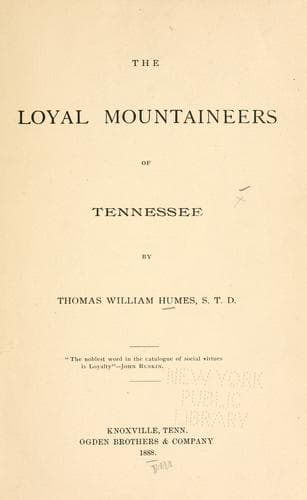
The loyal mountaineers of TennesseeHumes, Thomas William
Philosophy
The loyal mountaineers of Tennessee
Humes, Thomas William
Tennessee, East -- History -- Civil War, 1861-1865
These were citizens whose names commended the appointment they made
to general attention and to the co-operation of all who sympathised
in its object: and at the time proposed, being Thursday, the
Convention assembled at Temperance Hall, Knoxville. The delegates
present numbered four hundred and sixty-nine, representing twenty-six
counties, which with two other counties represented by two resident
proxies, constituted nearly the whole of East Tennessee. As the
meeting was held in Knox County, and therefore was more easy of
access to its delegates, they were much more numerously appointed
and in attendance than were those from any other county. Still there
were three hundred and twenty-seven present from other counties.
Contiguity to the place of assembling, would of course affect
more or less the relative attendance from all parts of the region
included in the convention, but so too would the degrees of Union
sentiment existing in them. Accordingly, of counties immediately
adjacent to Knoxville and strongly devoted to the Union, there
were delegates from Anderson, Blount, Jefferson, Union, Roane and
Sevier, aggregating one hundred and fifty-eight; Roane sending the
largest number and Jefferson the smallest. Among delegates from
other counties lying in the great valley, there were twenty-eight
from Greene and twenty-four from McMinn: Hamilton, at the extreme
southwest, equalled McMinn in numbers, and Sullivan, at the
extreme northeast, had a sufficient Union element to send six
representatives. Distance lessened attendance from the mountain
counties: but Johnson sent thirteen delegates from the far east,
and Carter five; and although travel on horseback was difficult at
a time so troubled, ten were present from Campbell County on the
north, and six from Morgan on the west. In Scott County, east of
Morgan, the mountains pierce the clouds, the scenery is grand and
the slaves were only one in forty-five of the population. It was its
people in their high and peaceful homes who did not hear that South
Carolina had seceded until the event lost all its freshness as news:
and possibly tidings of the convention at Knoxville had not gone to
them with enough fleetness of wing to give timely information. Yet
they were alive and awake to the worth of “Liberty and Union,--one
and inseparable,--now and forever!” and the time would come to them
for action. The tidal wave of battle would ere long toss its foam
and spray upon the foundations of the everlasting hills among which
they dwelt; and they would do their part in saving the ship of state
from being wrecked in the storm. Rhea County and Sequatchie, a little
county embedded in the mountains north of Chattanooga, were the only
ones in East Tennessee unrepresented in the convention; but why, does
not appear.[20]
Public-domain text, read in full here on John Shaqi.
Reviews
Reviews
No reviews yet
Be the first to share your thoughts on this work.
Join the Discussion
Join the discussion
Sign in to leave a comment or review.
Sign InorCreate an account