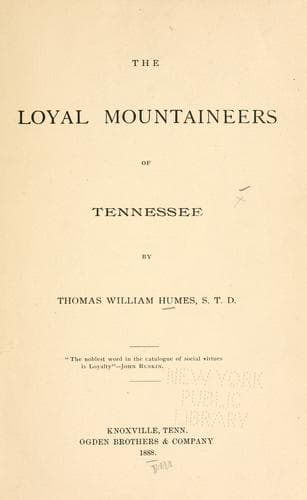
The loyal mountaineers of TennesseeHumes, Thomas William
Philosophy
The loyal mountaineers of Tennessee
Humes, Thomas William
Tennessee, East -- History -- Civil War, 1861-1865
The Hon. Thos. A. R. Nelson was less fortunate than Mr. Maynard. He
attempted to pass from his home at Jonesboro through the southwestern
corner of Virginia into Kentucky. At Cumberland Gap the lines of
Virginia, Kentucky and Tennessee converge to a point. It was already
occupied by Confederate troops, and a small body of them intercepted
him on the road at night. He was taken by way of Abingdon, Va., to
Richmond a prisoner, and had to run the gauntlet of infuriated and
threatening people at the various railway stations. After a short
detention in custody, he was released upon giving a written promise
to the President of the Confederacy to abstain from overt acts of
hostility against it, and returned to dwell peaceably in Tennessee.
The Hon. George W. Bridges, of the Third or Athens District,
contrived to effect his escape into Kentucky through the Cumberland
Mountains in Fentress County, Tennessee. It was pre-arranged that
his wife and children should immediately follow him, but they were
made the means of ensnaring his feet. The Confederate commander of a
post on the border detained his family, decoyed him to return by a
message of his wife’s illness, and then placed him in arrest. Another
instance was thus added to the many furnished by history, teaching
that in all important and dangerous enterprises it is wise to “look
not back,” even for the sake of cherished objects of natural
affection, lest through the adroit use of them by enemies, they
become fatal impediments. Mr. Bridges was carried to Knoxville, where
he signed a pledge or took an oath of submission to the Confederacy.
In a short time he obtained permission to pass into Kentucky to
transact a matter of business, and improved that opportunity to
extend his journey to Washington, where he served a term in Congress.
[Illustration: HON. ANDREW JOHNSON.]
Hon. Andrew Johnson had preceded Mr. Maynard to that city. In June
the _Richmond_ (Va.) _Enquirer_ had made publication concerning a
recent transaction at Knoxville which, if Mr. Johnson were indeed
a party to it, seriously involved him; but the facts went to show
that an attempt had been made to obtain money for political uses by
the forgery of his name. On the 30th of that month he published from
Washington a statement, “in order,” to use his own words, “to expose
the dishonorable and wicked means resorted to by ‘Secession’ to carry
out its nefarious and corrupt designs in attempting to overthrow and
break up the best Government the world ever saw.”
Mr. Amos A. Lawrence, of Boston, received a forged letter, marked
PRIVATE, and dated “Knoxville, Tenn., May 15, 1861”--on which day
Andrew Johnson, whose signature it bore, was addressing a Union
Convention at Elizabethton, one hundred and eighteen miles from
Knoxville. It read:
DEAR SIR: I received your kind favor on yesterday and hasten
to reply. Thank you for the high regard you seem to have for my
patriotism and my devotion to my country.
Public-domain text, read in full here on John Shaqi.
Reviews
Reviews
No reviews yet
Be the first to share your thoughts on this work.
Elsewhere in the archive
Join the Discussion
Join the discussion
Sign in to leave a comment or review.
Sign InorCreate an account