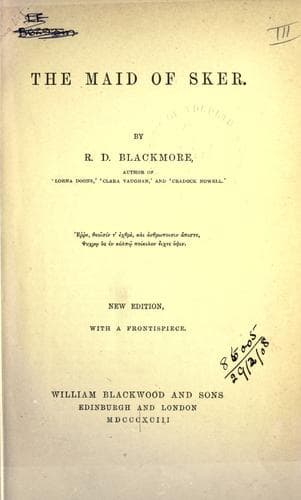
The Maid of SkerBlackmore, R. D. (Richard Doddridge)
General
The Maid of Sker
Blackmore, R. D. (Richard Doddridge)
Foundlings -- Fiction; Romance fiction; Wales -- Fiction
Everybody may be sure that I never would have gone out of the way to
describe my traffic with that man unless there were good reason. Nay,
but I wanted to show you exactly the cast and the colour of man he was,
by setting forth his low attempt to get my fish for nothing.
There was no man, of course, in my native village, and very few in
Bridgend perhaps, to whom I would have sold those fish, unless they were
going to sell it again. But Hezekiah Perkins, a member and leading elder
of the "Nicodemus-Christians," was so hard a man to cheat--except by
stirring of his gall--and so keen a cheat himself; so proud, moreover,
of his wit and praying, and truly brotherly,--that to lead him astray
was the very first thing desired by a sound Churchman.
By trade and calling he had been--before he received his special
call--no more than a common blacksmith. Now a blacksmith is a most
useful man, full of news and full of jokes, and very often by no means
drunk; this, however, was not enough to satisfy Hezekiah. Having parts,
as he always told us--and sometimes we wished that he had no
whole--cultivated parts, moreover, and taken up by the gentry, nothing
of a lower order came up to his merits than to call himself as follows:
"Horologist, Gunsmith, Practical Turner, Working Goldsmith and Jeweller,
Maker of all Machinery, and Engineman to the King and Queen."
The first time he put this over his door, all the neighbours laughed at
him, knowing (in spite of the book he had got full of figures and shapes
and crossings, which he called "Three-gun-ometry") that his education
was scarcely up to the rule of three, without any guns. Nevertheless he
got on well, having sense enough to guide him when to talk large (in the
presence of people who love large talk, as beyond them), and when to
sing small, and hold his tongue, and nod at the proper distances, if
ever his business led him among gentry of any sense or science, such as
we sometimes hear of. Hence it was that he got the order to keep the
church-clock of Bridgend a-going by setting the hands on twice a-day,
and giving a push to the pendulum; and so long as the clock would only
go, nobody in the town cared a tick whether it kept right time or wrong.
And if people from the country durst say anything about it, it was
always enough to ask them what their own clocks had to say.
Public-domain text, read in full here on John Shaqi.
Reviews
Reviews
No reviews yet
Be the first to share your thoughts on this work.
Elsewhere in the archive
Join the Discussion
Join the discussion
Sign in to leave a comment or review.
Sign InorCreate an account