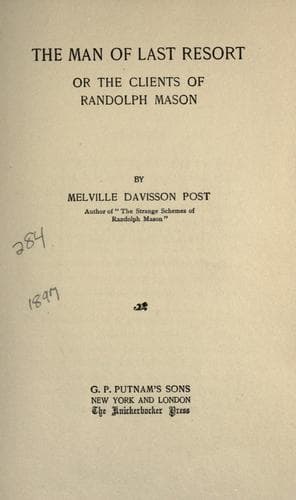
The Man of Last Resort; Or, The Clients of Randolph MasonPost, Melville Davisson
General
The Man of Last Resort; Or, The Clients of Randolph Mason
Post, Melville Davisson
American fiction -- 19th century; Detective and mystery stories, American; Legal stories, American
“It is unnecessary, I judge, to weary you with further details. Under
the remarkable handling of this man, the element of substantial wrong
seemed to disappear from the transaction, and the result was that I
finally consented to join with him. He claimed two hundred thousand
dollars. I reported to the company a complete loss, but advised a
settlement at not more than one half of the sum claimed. This finally
led to an adjustment at about one hundred and twenty thousand dollars,
without the least suspicion of a community of interests between us.
“It would not be quite true to assume that I easily fell in with Hall's
plan, although in point of time it would seem so. Financially, I was
in a bad way; from childhood I had been poor; always poor. In money
matters, things invariably went wrong. Every hazard I had taken, every
speculation in which I had entered, had always lost, no matter how
substantial it seemed. At this time I was rather desperate, I presume.
At any rate, I joined with the scheme, and it succeeded without a jar.
“Thus I came to know Brown Hirst under his alias. We divided the money
and deposited it with a trust company in Philadelphia until such time
as we might safely join in some one of the numerous ventures which Brown
Hirst was continually planning. But he was no dreamer, this Hirst. He
knew fully the great virtue of deliberation, and insisted that I
remain with the insurance company for at least a year, and then secure
employment with another company on some reasonable pretext, and then by
some error be discharged from this company, and if possible join with
another, until finally I should drift out of the business without being
subject to speculative comment.
“These suggestions of Hirst I followed to the letter, and they resulted
as he anticipated. I had now great confidence in the ability of this
remarkable man. The details of his plans were as accurate as the pieces
of a machine, and they seemed never capable of failure.”
The coal operator paused and rested his hands on the arms of his chair.
“Even now,” he said, “I consider Brown Hirst to have been the ablest man
I ever saw.”
Randolph Mason was silent. His face indicated rather more of weariness
than of interest. Perhaps the story in its substance was very old to
him.
“On the first day of September, 1893, I joined Brown Hirst in
Philadelphia, and here he unfolded a number of gigantic plans, among
others one for defrauding life insurance companies, which we finally
decided to attempt. I do not now recall that I felt any real repugnance
to the moral obliquity of these ventures. The mastermind of Hirst seemed
to sweep out any moral consideration, by simply ignoring it utterly.
When Hirst planned, it was all business, and, according to the ethics
of business, quite as right as any. Indeed, the man was so phenomenally
successful where I had always failed, that I never once dreamed of
objecting to any plan which he deemed wise.
Public-domain text, read in full here on John Shaqi.
Reviews
Reviews
No reviews yet
Be the first to share your thoughts on this work.
Elsewhere in the archive
Join the Discussion
Join the discussion
Sign in to leave a comment or review.
Sign InorCreate an account