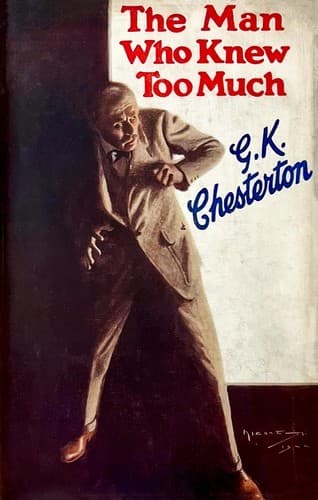
The Man Who Knew Too MuchChesterton, G. K. (Gilbert Keith)
ReligionComparative
The Man Who Knew Too Much
Chesterton, G. K. (Gilbert Keith)
Aristocracy (Social class) -- Fiction; Detective and mystery stories, English; Great Britain -- Fiction
"I mustn't appear on false pretences," he said, with a smile. "I
hardly even know what an archaeologist is, except that a rather
rusty remnant of Greek suggests that he is a man who studies old
things."
"Yes," replied Haddow, grimly. "An archaeologist is a man who
studies old things and finds they are new."
Crane looked at him steadily for a moment and then smiled again.
"Dare one suggest," he said, "that some of the things we have been
talking about are among the old things that turn out not to be old?"
His companion also was silent for a moment, and the smile on his
rugged face was fainter as he replied, quietly:
"The wall round the park is really old. The one gate in it is
Gothic, and I cannot find any trace of destruction or restoration.
But the house and the estate generally--well the romantic ideas read
into these things are often rather recent romances, things almost
like fashionable novels. For instance, the very name of this place,
Prior's Park, makes everybody think of it as a moonlit mediaeval
abbey; I dare say the spiritualists by this time have discovered the
ghost of a monk there. But, according to the only authoritative
study of the matter I can find, the place was simply called Prior's
as any rural place is called Podger's. It was the house of a Mr.
Prior, a farmhouse, probably, that stood here at some time or other
and was a local landmark. Oh, there are a great many examples of the
same thing, here and everywhere else. This suburb of ours used to be
a village, and because some of the people slurred the name and
pronounced it Holliwell, many a minor poet indulged in fancies about
a Holy Well, with spells and fairies and all the rest of it, filling
the suburban drawing-rooms with the Celtic twilight. Whereas anyone
acquainted with the facts knows that 'Hollinwall' simply means 'the
hole in the wall,' and probably referred to some quite trivial
accident. That's what I mean when I say that we don't so much find
old things as we find new ones."
Crane seemed to have grown somewhat inattentive to the little
lecture on antiquities and novelties, and the cause of his
restlessness was soon apparent, and indeed approaching. Lord
Bulmer's sister, Juliet Bray, was coming slowly across the lawn,
accompanied by one gentleman and followed by two others. The young
architect was in the illogical condition of mind in which he
preferred three to one.
Public-domain text, read in full here on John Shaqi.
Reviews
Reviews
No reviews yet
Be the first to share your thoughts on this work.
Elsewhere in the archive
Join the Discussion
Join the discussion
Sign in to leave a comment or review.
Sign InorCreate an account