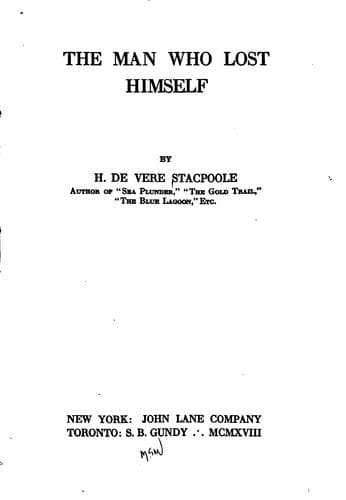
The Man Who Lost HimselfStacpoole, H. De Vere (Henry De Vere)
General
The Man Who Lost Himself
Stacpoole, H. De Vere (Henry De Vere)
Mistaken identity -- Fiction
Now the only thing that Jones had ever played in his life was the Star
Spangled Banner and that with one finger--Chopin's Spianato!
"No," he said. "I'd rather talk."
"Well, talk then--mercy! There's the first gong."
A faint and far away sound invaded the room, throbbed and ceased. She
rose, picked up her gloves, which she had cast on a chair, and then
peeped at herself in a mirror by the piano.
"You have never kissed me," said she, speaking as it were half to
herself and half to him, seeming to be more engaged in a momentary
piercing criticism of the hat she was wearing than in thoughts of
kisses. He came towards her like a schoolboy, then, as she held up her
face he imprinted a chaste kiss upon her right cheek bone.
Then the most delightful thing that ever happened to mortal man happened
to him. Two warm palms suddenly took his face between them and two moist
lips met his own.
Then she was gone.
He took his seat on the music stool, dazed, dazzled, delighted, shocked,
frightened, triumphant.
The position was terrific.
Jones was no Lothario. He was a straight, plain, common-sensical man
with a high respect for women, and the position of leading character in
a bad French comedy was not for him. Jones would just as soon have
thought of kissing another man's wife as of standing on his head in the
middle of Broadway.
To personate another man and to kiss the other man's wife under that
disguise would have seemed to him the meanest act any two-legged
creature could perform.
And he had just done it. And the other man's wife had--heu! his face
still burned.
She had done it because of his deception.
He found himself suddenly face to face with the barrier that Fate had
been cunningly constructing and had now placed straight before him.
There was no getting over it or under it, he would have to declare his
position _at once_--and what a position to declare!
She loved Rochester.
All at once that terrific fact appeared before him in its true
proportions and its true meaning.
She loved Rochester.
He had to tell her the truth. Yet to tell her the truth he would have to
tell her that the man she loved was dead.
Then she would want proofs.
He would have to bring up the Savoy Hotel people, fetch folk from
America--disinter Rochester. Horror! He had never thought of that. What
had become of Rochester? Up to this he had never thought once of what
had become of the mortal remains of the defunct jester, nor had he cared
a button--why should he?
But the woman who loved Rochester would care. And he, Jones, would
become in her eyes a ghoul, a monstrosity, a horror.
He felt a tinge of that feeling towards himself now. Up to this
Rochester had been for him a mechanical figure, an abstraction, but the
fact of this woman's love had suddenly converted the abstraction into a
human being.
Public-domain text, read in full here on John Shaqi.
Reviews
Reviews
No reviews yet
Be the first to share your thoughts on this work.
Join the Discussion
Join the discussion
Sign in to leave a comment or review.
Sign InorCreate an account