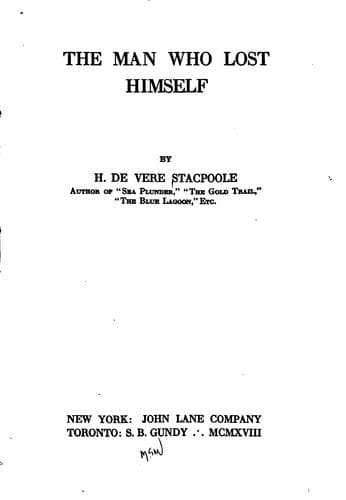
The Man Who Lost HimselfStacpoole, H. De Vere (Henry De Vere)
General
The Man Who Lost Himself
Stacpoole, H. De Vere (Henry De Vere)
Mistaken identity -- Fiction
It did not seem to matter to her in the least whether the flunkeys in
waiting were listening or not, she talked of the family, of "your mater"
and "Blunders" and "V" and other people, touching, it seemed on the most
intimate matters and all with a lightness of tone and spirit that would
have been delightful, no doubt, had he known the discussed ones more
intimately, and had his mind been open to receive pleasurable
impressions.
He would have to tell her directly after dinner the whole of his
terrible story. It was as though Fate were saying to him, "You will have
to kill her directly after dinner."
All that light-hearted chatter and new found contentment, all that
brightness would die. Grief for the man she loved, hatred of the man who
had supplanted him, anguish, perplexity, terror, would take their
places.
When the terrible meal was over, she ordered coffee to be served in the
music-room. He lingered behind for a moment, fiddling with a cigarette.
Then, when he came into the hall with the sweat standing in beads upon
his forehead, he heard the notes of the piano.
It was a Mazurka of Chopin's, played with gaiety and brilliancy, yet no
funeral march ever sounded more fatefully in the ears of mortal.
He could not do it. Then--he turned the handle of the music-room door
and entered.
CHAPTER XVII
THE SECOND HONEYMOON
Only three of the electric lights were on in the music-room. In the rosy
light and half shadows the room looked larger than when seen in
daylight, and different.
She had wandered from the Mazurka into Paderewski's Melodie Op. 8. No.
3, a lonesome sort of tune it seemed to him, as he dropped into a chair,
crossed his legs and listened.
Then as he listened he began to think. Up to this his thoughts had been
in confusion, chasing one another or pursued by the monstrosity of the
situation. Now he was thinking clearly.
She was his, that girl sitting there at the piano with the light upon
her hair, the light upon her bare shoulders and the sheeny fabric of her
dress. He had only to stretch out his hand and take her. Absolutely his,
and he had only met her twice. She was the most beautiful woman in
London, she had a mind that would have made a plain woman attractive,
and a manner delightful, full of surprises and contrarieties and
tendernesses--and she loved him.
The Arabian Nights contained nothing like this, nor had the brain that
conceived Tantalus risen to the heights achieved by accident and
coincidence.
She finished the piece, rose, turned over some sheets of music and then
came across the room--floated across the room, and took her perch on the
arm of the great chair in which he was sitting. Then he felt her fingers
on his hair.
Public-domain text, read in full here on John Shaqi.
Reviews
Reviews
No reviews yet
Be the first to share your thoughts on this work.
Elsewhere in the archive
Join the Discussion
Join the discussion
Sign in to leave a comment or review.
Sign InorCreate an account