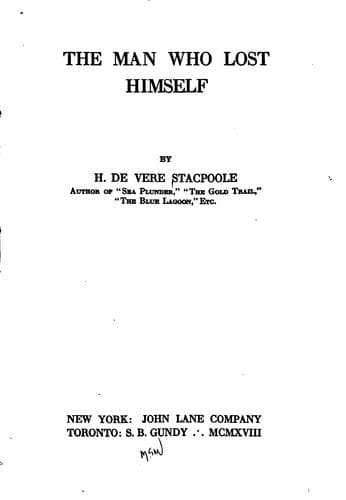
The Man Who Lost HimselfStacpoole, H. De Vere (Henry De Vere)
General
The Man Who Lost Himself
Stacpoole, H. De Vere (Henry De Vere)
Mistaken identity -- Fiction
The acutest physical suffering could not have been worse than that
torture of the over-taxed brain, that feeling that if he did not clutch
at _himself_ he would become nothing.
He ran for a few yards--then it passed and he found himself beneath a
lamp-post recovering and muttering his own name rapidly to himself like
a charm to exorcise evil.
"Jones--Jones--Jones."
He looked around.
There were not many people to be seen, but a man and woman a few yards
away were standing and looking at him. They had evidently stopped and
turned to see what he was about and they went on when they saw him
observing them.
They must have thought him mad.
The hot shame of the idea was a better stimulant than brandy. He walked
on. He was no longer thinking of the woman he had just left. He was
thinking of himself.
He had been false to himself.
The greatest possession any man can have in the world is himself. Some
men let that priceless property depreciate, some improve it, it is given
to few men to tamper with it after the fashion of Jones.
He saw this now, and just as though a pit had opened before him he drew
back. He must stop this double life at once and become his own self in
reality; failing to do that he would meet madness. He recognised this.
No man's brain could stand what he had been going through for long; had
he been left to himself he might have adapted his mind gradually to the
perpetual shifting from Jones to Rochester and vice versa. The woman had
brought things to a crisis. The horror that had now suddenly fallen on
him, the horror of the return of that awful feeling of negation, the
horror of losing himself, cast all other considerations from his mind.
He must stop this business at once.
He would go away, return straight to America.
That was easy to be done--but would that save him? Would that free him
from this horrible clinging personality that he had so lightly cast
around himself?
Nothing is stranger than mind. From the depth of his mind came the
whisper, "No." Intuition told him that were he to go to Timbuctoo,
Rochester would cling to him, that he would wake up from sleep fancying
himself Rochester and then that feeling would return. What he required
was the recognition by other people that he was himself, Jones, that the
whole of this business was a deception, a stage play in real life. Their
abuse, their threats would not matter. Their blows would be welcome, so
he thought. Anything that would hit him back firmly into his real
position in the scheme of things and save him from the dread of some day
losing himself.
Public-domain text, read in full here on John Shaqi.
Reviews
Reviews
No reviews yet
Be the first to share your thoughts on this work.
Elsewhere in the archive
Join the Discussion
Join the discussion
Sign in to leave a comment or review.
Sign InorCreate an account