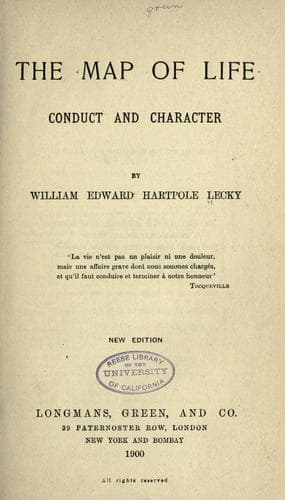
The Map of Life: Conduct and CharacterLecky, William Edward Hartpole
Philosophy
The Map of Life: Conduct and Character
Lecky, William Edward Hartpole
Character; Conduct of life
No one, I think, has seen more clearly or described more vividly than
Goethe the direction in which in modern times the current of morals is
flowing. His philosophy is a terrestrial philosophy, and the old
theologians would have said that it allowed the second Table of the Law
altogether to supersede or eclipse the first. It was said of him with
much truth that 'repugnance to the supernatural was an inherent part of
his mind.' To turn away from useless and barren speculations; to
persistently withdraw our thoughts from the unknowable, the inevitable,
and the irreparable; to concentrate them on the immediate present and on
the nearest duty; to waste no moral energy on excessive introspection or
self-abasement or self-reproach, but to make the cultivation and the
wise use of all our powers the supreme ideal and end of our lives; to
oppose labour and study to affliction and regret; to keep at a distance
gloomy thoughts and exaggerated anxieties; 'to see the individual in
connection and co-operation with the whole,' and to look upon effort and
action as the main elements both of duty and happiness, was the lesson
which he continually taught. 'The mind endowed with active powers, and
keeping with a practical object to the task that lies nearest, is the
worthiest there is on earth.' 'Character consists in a man steadily
pursuing the things of which he feels himself capable.' 'Try to do your
duty and you will know what you are worth.' 'Piety is not an end but a
means; a means of attaining the highest culture by the purest
tranquillity of soul.' 'We are not born to solve the problems of the
world, but to find out where the problem begins and then to keep within
the limits of what we can grasp.'
To cultivate sincere love of truth and clear and definite conceptions,
and divest ourselves as much as possible from prejudices, fanaticisms,
superstitions, and exaggeration; to take wide, sound, tolerant,
many-sided views of life, stands in his eyes in the forefront of ethics.
'Let it be your earnest endeavour to use words coinciding as closely as
possible with what we feel, see, think, experience, imagine, and
reason;' 'remove by plain and honest purpose false, irrelevant and
futile ideas.' 'The truest liberality is appreciation.' 'Love of truth
shows itself in this, that a man knows how to find and value the good in
everything.'[22]
Public-domain text, read in full here on John Shaqi.
Reviews
Reviews
No reviews yet
Be the first to share your thoughts on this work.
Elsewhere in the archive
Join the Discussion
Join the discussion
Sign in to leave a comment or review.
Sign InorCreate an account