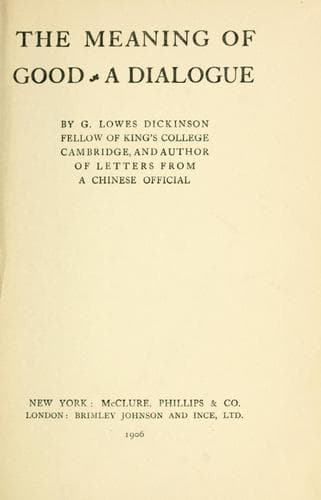
The Meaning of Good—A DialogueDickinson, G. Lowes (Goldsworthy Lowes)
Philosophy
The Meaning of Good—A Dialogue
Dickinson, G. Lowes (Goldsworthy Lowes)
Good and evil
"And meantime," I said, "you have not even the right to assume that
it is a good thing to endeavour to ascertain it. For the pursuit of
Truth, it must be admitted, is one of the things which we call
good; and these, we agreed, have not any relation to the true Good.
Consider, then, the position of these unfortunate men who have learnt
indeed that there is a Good, but who know nothing about it, except
that it has nothing to do with what they call good. What kind of life
will they live? Whatever they may put their hand to, they will at once
be paralyzed by the thought that it cannot possibly be worth pursuing.
Politics, art, pleasure, science--of these and all other ends
they know but one thing, that all is vanity. As by the touch of
enchantment, their world is turned to dust. Like Tantalus they stretch
lips and hands towards a water for ever vanishing, a fruit for
ever withdrawn. At war with empty phantoms, they 'strike with their
spirit's knife,' as Shelley has it, 'invulnerable nothings,' Dizzy and
lost they move about in worlds not only unrealized, but unrealizable,
'children crying in the night, with no language but a cry,' and no
father to cry to. And in all this blind confusion the only comfort
vouchsafed is that somehow or other they may, they cannot tell how,
discover a Good of which the only thing they know is that it has no
connection with the Goods they have lost. Is not this a fair account
of the condition to which men would be reduced who really did accept
and believe your hypothesis?"
"Yes," he said, "perhaps it is, but still I must protest against this
appeal to prejudice and passion. Supposing the truth really were as I
suggested, we should have to face it, whether or no it seemed to ruin
our own life."
"Yes," I agreed, "supposing the truth were so. But, after all, we have
no sufficient theoretical reason for believing it to be so, and
every kind of practical reason against it. We cannot, it is true,
demonstrate--and that was admitted from the first--that any of our
judgments about what is good are true; but there is no reason why we
should not believe--and I should say we must believe--that somehow or
other they do at least have truth in them."
"Well, and if so?"
"If so, we do not depend, as you said we do, or at least we do not
believe ourselves to depend, for our knowledge about Good, upon some
purely rational process not yet discovered; but those things which
we judge to be good really, we think, in some sense or so, and by
analyzing and classifying and comparing our experiences of such things
we may come to see more clearly what it is in them that we judge to be
good; and again by increasing experience we may come to know more Good
than we knew; and generally, if we once admit that we have some light,
we may hope, by degrees, to get more; and that getting of more light
will be the most important business, not only of philosophy, but of
life."
Public-domain text, read in full here on John Shaqi.
Reviews
Reviews
No reviews yet
Be the first to share your thoughts on this work.
Join the Discussion
Join the discussion
Sign in to leave a comment or review.
Sign InorCreate an account