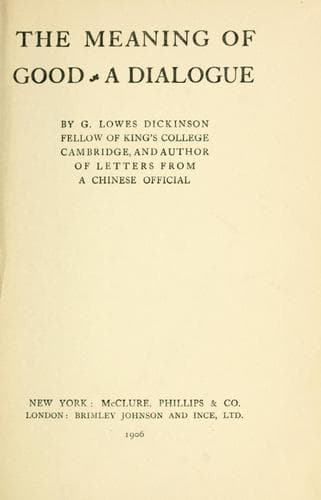
The Meaning of Good—A DialogueDickinson, G. Lowes (Goldsworthy Lowes)
Philosophy
The Meaning of Good—A Dialogue
Dickinson, G. Lowes (Goldsworthy Lowes)
Good and evil
"But that expenditure, as we now see, was futile and absurd. The
purposes to which it was directed were not really good, nor had they
any tendency to promote Good, unless it were in some particular
case by some fortunate chance. Whatever men have striven to achieve,
whether like Christ, to found a religion, or, like Cæsar, to found
a polity, whether their quest were virtue or power or truth, or any
other of the ends we are accustomed to value and praise, or whether
they sought the direct opposites of these, or simply lived from hour
to hour following without reflexion the impulse of the moment, in any
and every case all alike, great and small, good and bad, leaders and
followers, or however else we may class them, were, in fact, equally
insignificant and absurd, the idle sport of illusions, one as
empty and baseless as another. The history of nations, the lives
of individual men, are stripped, in this view, of all interest and
meaning; nowhere is there advance or retrogression, nowhere better or
worse, nowhere sense or consistency at all. Systems, however imposing,
structures, however vast, fly into dust and powder at a touch. The
stars fall from the human firmament; the beacon-lights dance like
will-o'-the-wisps; the whole universe of history opens, cracks, and
dissolves in smoke; and we, from an ever-vanishing shore, gaze with
impotent eyes at the last gleam on the wings of the dove of Reason as
it dips for ever down to eternal night. Will not that be the only
view we can take of the course of human action if we hold that what we
believe to be goods have no relation to the true Good?"
"Yes," he admitted, "I suppose it will."
"And if we turn," I continued, "from the past to the present and the
future, we find ourselves, I think, in even worse case. For we
shall all, those of us who may come to accept the hypothesis you put
forward, be deprived of the consolation even of imagining a reason and
purpose in our lives. The great men of the past, at any rate, could
and did believe that they were helping to realize great Goods; but
we, in so far as we are philosophers, shall have to forego even that
satisfaction. We shall believe, indeed, that Good exists, and that
there is a method of discovering it by pure reason; but this method,
we may safely assume, we shall not most of us have ascertained. Or do
you think we shall?"
"I cannot tell," he said; "I do not profess to have ascertained it
myself."
Public-domain text, read in full here on John Shaqi.
Reviews
Reviews
No reviews yet
Be the first to share your thoughts on this work.
Join the Discussion
Join the discussion
Sign in to leave a comment or review.
Sign InorCreate an account