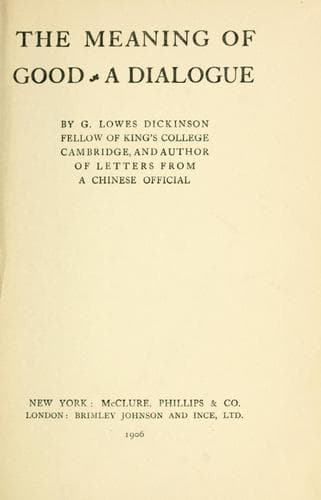
The Meaning of Good—A DialogueDickinson, G. Lowes (Goldsworthy Lowes)
Philosophy
The Meaning of Good—A Dialogue
Dickinson, G. Lowes (Goldsworthy Lowes)
Good and evil
"I would not say that," I replied, "though I am bound to confess
that I see no place for what you call pure Reason. It is the part of
Reason, on my hypothesis, to tabulate and compare results. She
does not determine directly what is good, but works, as in all the
sciences, upon given data, recording the determinations not (in this
case) of the outer but of the inner sense, noticing what kinds of
activity satisfy, and to what degree, the expanding nature of this
soul that seeks Good, and deducing therefrom, so far as may be,
temporary rules of conduct based upon that unique and central
experience which is the root and foundation of the whole. Temporary
rules, I say, because, by the nature of the case, they can have in
them nothing absolute and final, inasmuch as they are mere deductions
from a process which is always developing and transforming itself.
Systems of morals, maxims of conduct are so many landmarks left to
show the route by which the soul is marching; casts, as it were, of
her features at various stages of her growth, but never the final
record of her perfect countenance. And that is why the current
morality, the positive institutions and laws, on which Parry insisted
with so much force, both have and have not the value he assigned to
them. They are in truth invaluable records of experience, and he is
rash who attacks them without understanding; and yet, in a sense,
they are only to be understood in order to be superseded, because the
experience they resume is not final, but partial and incomplete. Would
you agree with that, Parry, or no?"
"I am not sure," he said. "It would be a dangerous doctrine to put in
practice."
"Yes," I said, "but I fear that life itself is a dangerous thing,
and nothing we can do will make it safe. Our only hope is courage and
sanity."
"But," said Dennis, "to return to the other point, on your view is our
knowledge of Good altogether subsequent to experience?"
"Yes," I replied, "our knowledge is, if you like; but it is a
knowledge of experience in Good. We first recognize Good by what
I call direct perception; then we analyze and define what we have
recognized; and the results of this process, I suppose, is what we
call knowledge, so far as it goes."
"And there can be no knowledge of Good independent of experience?"
"I do not know; perhaps there might be; only I should like to suggest
that even if we could arrive at such a knowledge by pure reason, we
should have achieved only a definition of Good, not Good itself; for
Good, I suppose you will agree, must be a state of experience, not a
formula."
"Even if it be so," he said, "it might still be possible to arrive at
its formula by pure reason."
Public-domain text, read in full here on John Shaqi.
Reviews
Reviews
No reviews yet
Be the first to share your thoughts on this work.
Join the Discussion
Join the discussion
Sign in to leave a comment or review.
Sign InorCreate an account