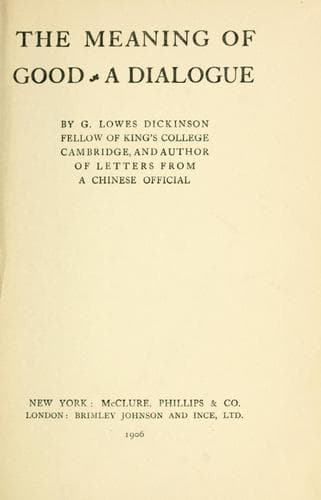
The Meaning of Good—A DialogueDickinson, G. Lowes (Goldsworthy Lowes)
Philosophy
The Meaning of Good—A Dialogue
Dickinson, G. Lowes (Goldsworthy Lowes)
Good and evil
"I cannot tell," I said, "perhaps it may. But, meantime, allow me to
press home the importance of your admission. For, as you say, there is
at least one of our aims which has a real significance, namely, that
of reaching the point of view of God. But this is something that lies
in the future, something to be brought about. And so, on your own
hypothesis, Good, after all, would not be that which eternally exists,
but something which has to be realized in time--namely, a change of
mind on the part of all rational beings, whereby they view the world
no longer in a partial imperfect way, but, in Spinoza's phrase, '_sub
specie æternitatis_'"
"No," he said, "I cannot admit that that is an end for the Absolute,
though I admit it is an end for us. The Absolute, somehow or other, is
eternally perfect and good; and this eternal perfection and goodness
are unaffected by any change that may take place in our minds."
"Well," I said, "I must leave it to the Absolute and yourself to
settle how that can possibly be. Meantime, I am content with your
admission that, for us, at least, there is an end and a Good lying
before us to be realized in the future. For that, as I understand, you
do admit. In your own life, for example, even if you aim at nothing
else, or at nothing else which you wholly approve, yet you do aim, at
least, with your whole nature at this--to attain a view of the world
as it may be conceived in its essence to be, not merely as it appears
to us."
"Yes," he said, "I admit that is my aim."
"That aim, then, is your Good?"
"I suppose so."
"And it is something, as I said, that lies in the future? For you do
not, I suppose, count yourself to have attained, or at least to have
attained as perfectly as you hope to?"
He agreed again.
"Well then," I continued, "what may be the relation of this Good of
yours, awaiting realization in the future, to that eternal Good of God
in which you also believe, we will reserve, with your permission, for
some future inquiry. It is enough for our present purpose that even
you, who assert the eternal perfection of the world, do nevertheless
at the same time admit a future Good; and much more do other men admit
it, who have no idea that the world is perfect at all. So that we may,
I think, safely suppose it to be generally agreed that the Good is
something to be realized in the future, so far, at any rate as it
concerns us--and, for my part, I have no desire to go farther than
that."
"Well," he said, "I am content for the present to leave the matter so.
But I reserve the right to go back upon the argument."
Public-domain text, read in full here on John Shaqi.
Reviews
Reviews
No reviews yet
Be the first to share your thoughts on this work.
Elsewhere in the archive
Join the Discussion
Join the discussion
Sign in to leave a comment or review.
Sign InorCreate an account