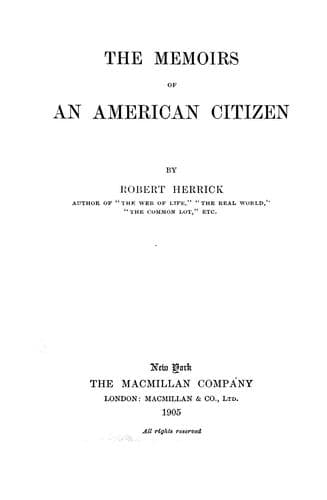
Capitalists and financiers -- Fiction; Chicago (Ill.) -- Fiction; Meat industry and trade -- Fiction; Political fiction
I was so upset that I didn't wait to open my letters, but called a cab
and started for the aunt's to find out what was the matter. It was just
as well I had been in a hurry, for in another ten minutes Miss Gentles
would have been on her way to Louisville, and it would have taken a week
to hunt out the small place in Kentucky where she was going. Her trunk
was packed, and she was sitting with her aunt in the large, ugly parlor,
waiting for the expressman to come. When I walked in, following the
servant, she didn't draw back her veil, but merely stood up and touched
fingers with me. I saw that something was so wrong that it had to be
made right at once, with no time to spare.
"You will kindly let me speak to Miss Gentles alone," I said to the
aunt, who was inclined to stick. She went out of the room ungraciously.
"Now," I said, taking the girl's hand and looking through her veil into
her eyes, "what is the matter? Tell me."
Her eyes were large and moist, and her lips quivered. But she shut her
teeth down hard and said stiffly: "Nothing whatever, Mr. Harrington. You
are very kind to come to see me before I leave."
"You aren't going to put me off with any such smooth answer as that," I
said, "or you will have my company all the way you're going, wherever it
may be. Tell me the straight truth, and all of it."
She began to laugh at my bluffing words, and ended with a nervous sob.
After a while I learned the whole story. It seems that the man I
employed talked out in the office about how he did all my work, and
while I was South one of the "lady" stenographers had said something to
Miss Gentles--a something she would not tell me. So she got up and took
her leave, and knowing that her old aunt wouldn't want her around if she
had no job, she had written some cousins in Kentucky and was going to
them.
The expressman came about this time, but he didn't take her trunk. And
when I left that chilly parlor we were engaged to be married. She said
at the last, putting her hands on my coat: "You know I always liked you,
even in the police station, Mr. Harrington--and--and I am so very, very
happy, now, Van! It was terrible to think of going away. I had to,
before you were due home. I was never so miserable before in my life!"
Something stirred from the bottom of my heart. I felt pitiful for all
her trouble, her weakness, her struggle with a world she wasn't made
for. Then she said trustingly, like a little child:--
"And you will always be good to me, as papa was with mamma, and patient,
and love me a great deal, won't you? Yes, I know you will!"
Public-domain text, read in full here on John Shaqi.
Reviews
Reviews
No reviews yet
Be the first to share your thoughts on this work.
Join the Discussion
Join the discussion
Sign in to leave a comment or review.
Sign InorCreate an account