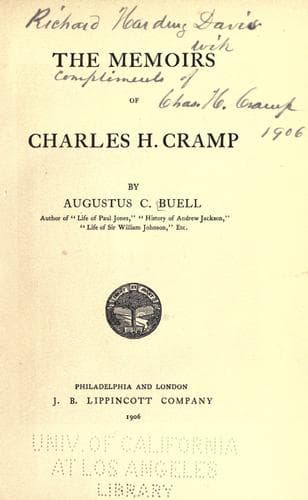
Cramp, Charles Henry, 1828-1913; Naval architects -- United States -- Biography
However, while the Lynch Committee was logical in its suggestion or
recommendation of remedy, its investigations, so far as the sum-total of
the causes of decline were concerned, and its estimate of those causes
were incomplete and inconclusive, because it started out with the dogma
that the then existing depression of the merchant marine was due wholly
to the ravages of the war; and it did not take into account the
correlative or co-operative facts of the situation, which were much
broader and deeper in their application and effect than the mere
suspension or destruction of our merchant marine by the war itself. In
other words, the Lynch Committee failed to grasp or appreciate the fact
that, while the war was wrecking our sea-going commerce, foreign
maritime powers, and particularly the English, were making the most
gigantic efforts not only to take the place of our ruined trade, but
also to provide for a perpetuity of the substitution, so that at any
time between the close of the war and the investigations of the Lynch
Committee it had become impossible for an American ship-owner to operate
a ship or a line of ships in any route of ocean traffic. By means of
liberal subsidies under the guise of mail pay, the British had in the
interim covered every sea-road and appropriated every channel of ocean
commerce. This fact the Lynch Committee seems to have ignored, although
it was really the prime factor in the situation, as it stood in 1870.
Mr. Cramp, in his statement before the Lynch Committee, went altogether
out of the beaten path pursued by most of the other ship-builders or
ship-owners who appeared. He said in effect that while the Civil War had
been an immediate cause of the destruction of our merchant marine as it
existed at the beginning of that struggle, still that was purely a
physical cause, and in the absence of other causes need not operate
after the war ended.
He called attention to the fact that the war had now been ended five
years, but that the condition of our merchant marine, particularly in
foreign trade, remained as pitiable as it had been in the height of the
struggle. This he said argued the existence of other and more lasting
causes than the simple destruction by war, whether by the government
taking up our merchant-ships for its own use, or by the transfer of a
great many of them to foreign flags to get the benefit of neutrality, or
by the actual depredations of Anglo-Confederate privateers.
He explained that during our misfortune the English took every advantage
in the way of appropriating to themselves and to their own ships the
traffic which our ships had formerly carried; that when the war closed,
they had absolute command of the ocean-carrying trade, our own as well
as theirs.
Public-domain text, read in full here on John Shaqi.
Reviews
Reviews
No reviews yet
Be the first to share your thoughts on this work.
Join the Discussion
Join the discussion
Sign in to leave a comment or review.
Sign InorCreate an account