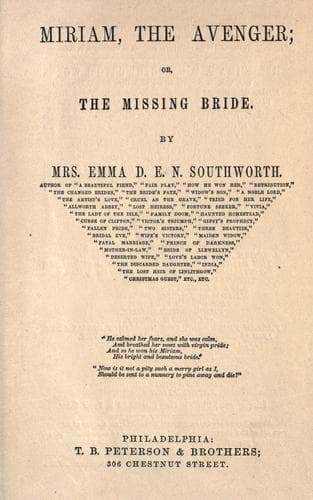
The Missing BrideSouthworth, Emma Dorothy Eliza Nevitte
General
The Missing Bride
Southworth, Emma Dorothy Eliza Nevitte
Fiction
At first seeing him her face flushed radiant with surprise and joy.
She seemed to think that nothing short of necromancy could have conjured
him to that spot. She had no reproaches for him, because she had no
suspicion that he had trifled with his promise not to seek her. But she
expressed her astonishment.
"I did not know you ever came this way," she said.
"Nor did I ever before, love; but I remembered my pledge, not to follow
or to seek you, and so I avoided the woodland path where we met last
Sunday," said Thurston, persuading himself that he spoke the precise
truth.
It is not necessary to pursue with them this walk; lovers scarcely thank
us for such intrusions. It is sufficient to say that this was not the
last one.
Blinded by passion and self-deception, and acting upon the same astute
calculus of probabilities, Thurston often contrived to meet Marian in
places where his presence might be least expected, and most often in
paths that she had taken for the express purpose of keeping out of his
way.
Thus it fell that many forest walks and seashore strolls were taken, all
through the lovely Indian summer weather. And these seemed so much the
result of pure accident that Marian never dreamed of complaining that
his pledge had been tampered with.
But Thurston began to urge her consent to a private marriage.
From a secret engagement to a secret marriage, the transition seemed to
him very easy.
"And, dearest Marian, we are both of age, both free--we should neither
displease God nor wrong man, by such a step--while it would at the same
time secure our union, and save us from injustice and oppression! do you
not see?"
Such was his argument, which he pleaded and enforced with all the powers
of passion and eloquence. In vain. Though every interview increased his
power over the maiden--though her affections and her will were both
subjected, the domain of conscience was unconquered. And Marian still
answered:
"Though a secret marriage would break no law of God or man, nor
positively wrong any human creature, yet it might be the cause of
misunderstanding and suspicion--and perhaps calumny, causing much
distress to those who love and respect me. Therefore it would be
wrong. And I must do no wrong, even for your dear sake."
CHAPTER XIV.
CLOUDY.
It was Christmas Eve and a fierce snow-storm was raging.
Old Mr. Willcoxen sat half doubled up in his leather-covered elbow
chair, in the chimney corner of his bedroom, occupied with smoking his
clay pipe, and thinking about his money bags.
Fanny was in the cold, bleak upper rooms of the house, looking out of
the windows upon the wide desolation of winter, the waste of snow, the
bare forest, the cold, dark waters of the bay--listening to the driving
tempest, and singing, full of glee as she always was when the elements
were in an uproar.
Public-domain text, read in full here on John Shaqi.
Reviews
Reviews
No reviews yet
Be the first to share your thoughts on this work.
Elsewhere in the archive
Join the Discussion
Join the discussion
Sign in to leave a comment or review.
Sign InorCreate an account