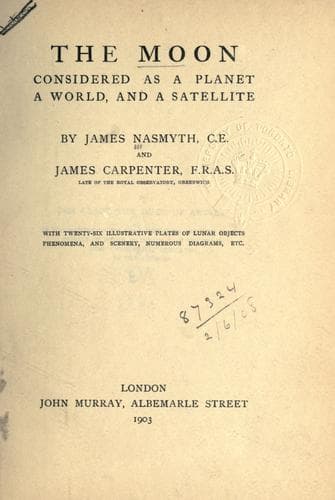
The Moon: considered as a planet, a world, and a satellite.Nasmyth, James
Science
The Moon: considered as a planet, a world, and a satellite.
Nasmyth, James
Moon
Reverting to the consequences of the terrestrial atmosphere: one of the
most striking of these is the phenomenon of diffused daylight, which we
need hardly remind the reader is produced by the scattering or diffusion
of the sun’s rays among the minute particles of vapour composing or
contained in that atmosphere. Were it not for this reflexion and
diffusion of the sun’s light, those parts of our earth not exposed to
direct sunshine would be hidden in darkness, receiving no illumination
beyond the feeble amount that might be reflected from proximate
terrestrial objects actually illuminated by direct sunlight. Twilight is
a consequence of this reflexion of light by the atmosphere when the sun
is below the horizon. If, then, an atmosphere enveloped the moon, we
should see by diffused light those parts of the lunar details that are
not receiving the direct solar beams; and before the sun rose and after
it had set upon any region of the moon, that region would still be
partially illuminated by a twilight. But, on the contrary, the shadowed
portions of a lunar landscape are pitchy black, without a trace of
diffused-light illumination, and the effects that a twilight would
produce are entirely absent from the moon. Once, indeed, one observer,
Schroeter, noticed something which he suspected was due to an effect of
this kind: when the moon exhibited itself as a very slender crescent, he
discovered a faint crepuscular light, extending from each of the cusps
along the circumference of the unenlightened part of the disc, and he
inferred from estimates of the length and breadth of the line of light
that there was an atmosphere about the moon of 5376 feet in height. This
is the only instance on record, we believe, of such an appearance being
seen.
[Illustration: Fig. 12.]
Public-domain text, read in full here on John Shaqi.
Reviews
Reviews
No reviews yet
Be the first to share your thoughts on this work.
Join the Discussion
Join the discussion
Sign in to leave a comment or review.
Sign InorCreate an account