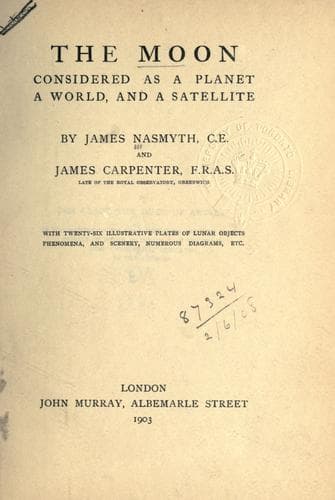
The Moon: considered as a planet, a world, and a satellite.Nasmyth, James
Science
The Moon: considered as a planet, a world, and a satellite.
Nasmyth, James
Moon
Spectrum analysis would also betray the existence of a lunar atmosphere.
The solar rays falling on the moon are reflected from its surface to the
earth. If, then, an atmosphere existed, it is plain that the solar rays
must first pass through such atmosphere to reach the reflecting surface,
and returning from thence, again pass through it on their way to the
earth; so that they must in reality pass through virtually twice the
thickness of any atmosphere that may cover the moon. And if there be any
such atmosphere, the spectrum formed by the moon’s light, that is, by
the sun’s light reflected from the moon, would be modified in such a
manner as to exhibit absorption-lines different from those found in the
spectrum of the direct solar rays, just as the absorption-lines vary
according as the sun’s rays have to pass through a thinner or a denser
stratum of the terrestrial atmosphere. Guided by this reasoning, Drs.
Huggins and Miller made numerous observations upon the spectrum of the
moon’s light, which are detailed in the “Philosophical Transactions” for
the year 1864; and their result, quoting the words of the report, was
“that the spectrum analysis of the light reflected from the moon is
wholly negative as to the existence of any considerable lunar
atmosphere.”
Upon another occasion, Dr. Huggins made an analogous observation of the
spectrum of a star at the moment of its occultation, which observation
he records in the following words:—“When an observation is made of the
spectrum of a star a little before, or at the moment of its occultation
by the dark limb of the moon, several phenomena characteristic of the
passage of the star’s light through an atmosphere might possibly present
themselves to the observer. If a lunar atmosphere exist, which either by
the substances of which it is composed, or by the vapours diffused
through it, can exert a selective absorption upon the star’s light, this
absorption would be indicated to us by the appearance in the spectrum of
new dark lines immediately before the star is occulted by the moon.”
“If finely divided matter, aqueous or otherwise, were present about the
moon, the red rays of the star’s light would be enfeebled in a smaller
degree than the rays of higher refrangibilities.”
“If there be about the moon an atmosphere free from vapour, and
possessing no absorptive power, but of some density, then the spectrum
would not be extinguished by the moon’s limb at the same instant
throughout its length. The violent and blue rays would lay behind the
red rays.”
“I carefully observed the disappearance of the spectrum of η Piscium at
its occultation of January 4, 1865, for these phenomena; but no signs of
a lunar atmosphere were detected.”
Public-domain text, read in full here on John Shaqi.
Reviews
Reviews
No reviews yet
Be the first to share your thoughts on this work.
Join the Discussion
Join the discussion
Sign in to leave a comment or review.
Sign InorCreate an account