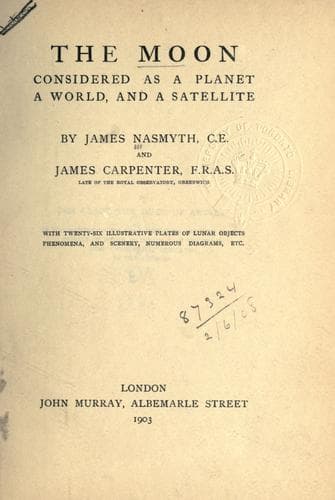
The Moon: considered as a planet, a world, and a satellite.Nasmyth, James
Science
The Moon: considered as a planet, a world, and a satellite.
Nasmyth, James
Moon
Comparisons of these two intervals of time have been repeatedly made,
the most recent and most extensive was executed under the direction of
the Astronomer-Royal several years ago, and it was based upon no less
than 296 occultation observations. In this determination the measured or
telescopic semidiameter of the moon was compared with the semidiameter
deduced from the occultations, upon the above principle, and it was
found that the telescopic semidiameter was greater than the occultation
semidiameter by two seconds of angular measurement or by about a
thousandth part of the whole diameter of the moon. Sir George Airy,
commenting on this result, says that it appears to him that the origin
of this difference is to be sought in one of two causes. “Either it is
due to irradiation[3] of the telescopic semidiameter, and I do not doubt
that a part at least of the two seconds is to be ascribed to that cause;
or it may be due to refraction by the moon’s atmosphere. If the whole
two seconds were caused by atmospheric refraction this would imply a
horizontal refraction of one second, which is only 1/2000 part of the
earth’s horizontal refraction. It is possible that an atmosphere
competent to produce this refraction would not make itself visible in
any other way.” This result accords well, considering the relative
accuracy of the means employed, with that obtained a century ago by the
French astronomer Du Séjour, who made a rigorous examination of the
subject founded on observations of the solar eclipse of 1764. He
concluded that the horizontal refraction produced by a possible lunar
atmosphere amounted to 1″·5—a second and a half—or about 1/1400 of that
produced by the earth’s atmosphere. The greater weight is of course to
be allowed to the more recent determination in consideration of the
large number of accurate observations upon which it was based.
But an atmosphere 2,000 times rarer than our air can scarcely be
regarded as an atmosphere at all. The contents of an air-pump receiver
can seldom be rarefied to a greater extent than to about 1/1000 of the
density of air at the earth’s surface, with the best of pneumatic
machines; and the lunar atmosphere, if it exist at all, is thus proved
to be twice as attenuated as what we are accustomed to recognise as a
vacuum. In discussing the physical phenomena of the lunar surface, we
are, therefore, perfectly justified in omitting all considerations of an
atmosphere, and adapting our arguments to the non-existence of such an
appendage.
Public-domain text, read in full here on John Shaqi.
Reviews
Reviews
No reviews yet
Be the first to share your thoughts on this work.
Elsewhere in the archive
Join the Discussion
Join the discussion
Sign in to leave a comment or review.
Sign InorCreate an account