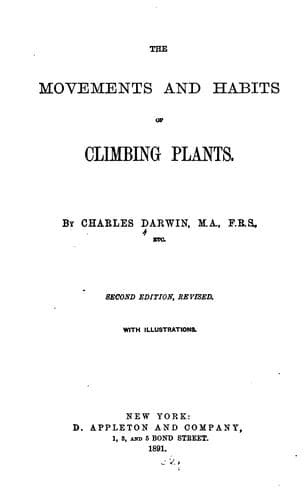
The Movements and Habits of Climbing PlantsDarwin, Charles
Science
The Movements and Habits of Climbing Plants
Darwin, Charles
Climbing plants; Geotropism; Plants; Plants -- Irritability and movements
and inefficient of all climbers!
_Bignonia Tweedyana_.—This species is closely allied to the last, and
behaves in the same manner; but perhaps twines rather better round a
vertical stick. On the same plant, one branch twined in one direction
and another in an opposite direction. The internodes in one case made
two circles, each in 2 hrs. 33 m. I was enabled to observe the
spontaneous movements of the petioles better in this than in the two
preceding species: one petiole described three small vertical ellipses in
the course of 11 hrs., whilst another moved in an irregular spire. Some
little time after a stem has twined round an upright stick, and is
securely fastened to it by the clasping petioles and tendrils, it emits
aërial roots from the bases of its leaves; and these roots curve partly
round and adhere to the stick. This species of _Bignonia_, therefore,
combines four different methods of climbing generally characteristic of
distinct plants, namely, twining, leaf-climbing, tendril-climbing, and
root-climbing.
In the three foregoing species, when the foot-like tendril has caught an
object, it continues to grow and thicken, and ultimately becomes
wonderfully strong, in the same manner as the petioles of leaf-climbers.
If the tendril catches nothing, it first slowly bends downwards, and then
its power of clasping is lost. Very soon afterwards it disarticulates
itself from the petiole, and drops off like a leaf in autumn. I have
seen this process of disarticulation in no other tendrils, for these,
when they fail to catch an object, merely wither away.
Public-domain text, read in full here on John Shaqi.
Reviews
Reviews
No reviews yet
Be the first to share your thoughts on this work.
Elsewhere in the archive
Join the Discussion
Join the discussion
Sign in to leave a comment or review.
Sign InorCreate an account