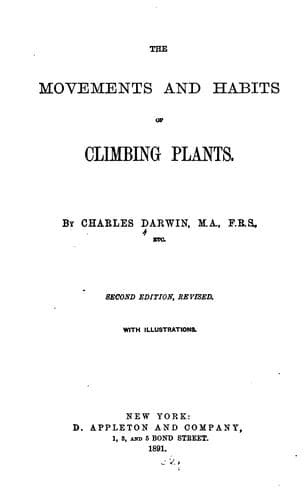
The Movements and Habits of Climbing PlantsDarwin, Charles
Science
The Movements and Habits of Climbing Plants
Darwin, Charles
Climbing plants; Geotropism; Plants; Plants -- Irritability and movements
_Bignonia æquinoctialis_, var. _Chamberlaynii_.—The internodes, the
elongated non-sensitive petioles, and the tendrils all revolve. The stem
does not twine, but ascends a vertical stick in the same manner as the
last species. The tendrils also resemble those of the last species, but
are shorter; the three toes are more unequal in length, the two outer
ones being about one-third shorter and rather thinner than the middle
toe; but they vary in this respect. They terminate in small hard points;
and what is important, cellular adhesive discs are not developed. The
reduced size of two of the toes as well as their lessened sensitiveness,
seem to indicate a tendency to abortion; and on one of my plants the
first-formed tendrils were sometimes simple, that is, were not divided
into three toes. We are thus naturally led to the three following
species with undivided tendrils:—
_Bignonia speciosa_.—The young shoots revolve irregularly, making narrow
ellipses, spires or circles, at rates varying from 3 hrs. 30 m. to 4 hrs.
40 m.; but they show no tendency to twine. Whilst the plant is young and
does not require a support, tendrils are not developed. Those borne by a
moderately young plant were five inches in length. They revolve
spontaneously, as do the short and non-sensitive petioles. When rubbed,
they slowly bend to the rubbed side and subsequently straighten
themselves; but they are not highly sensitive. There is something
strange in their behaviour: I repeatedly placed close to them, thick and
thin, rough and smooth sticks and posts, as well as string suspended
vertically, but none of these objects were well seized. After clasping
an upright stick, they repeatedly loosed it again, and often would not
seize it at all, or their extremities did not coil closely round. I have
observed hundreds of tendrils belonging to various Cucurbitaceous,
Passifloraceous, and Leguminous plants, and never saw one behave in this
manner. When, however, my plant had grown to a height of eight or nine
feet, the tendrils acted much better. They now seized a thin, upright
stick horizontally, that is, at a point on their own level, and not some
way up the stick as in the case of all the previous species.
Nevertheless, the non-twining stem was enabled by this means to ascend
the stick.
Public-domain text, read in full here on John Shaqi.
Reviews
Reviews
No reviews yet
Be the first to share your thoughts on this work.
Elsewhere in the archive
Join the Discussion
Join the discussion
Sign in to leave a comment or review.
Sign InorCreate an account